
Rockstar Games has spent decades building some of the most recognizable fictional brand ecosystems in entertainment — and now, those brands are stepping off the screen. Reports confirmed in 2026 that in-game beer labels from GTA 6's fictional state of Leonida are being developed as actual, purchasable real-world products. That's not a fan project. That's a calculated IP strategy — and it changes what a "game launch" looks like.
This piece examines what the move means, where it fits inside Rockstar's broader GTA 6 marketing push, and whether the fictional-brand-to-real-product pipeline is a model the industry will copy.
What We Actually Know About GTA 6 Beer Brands
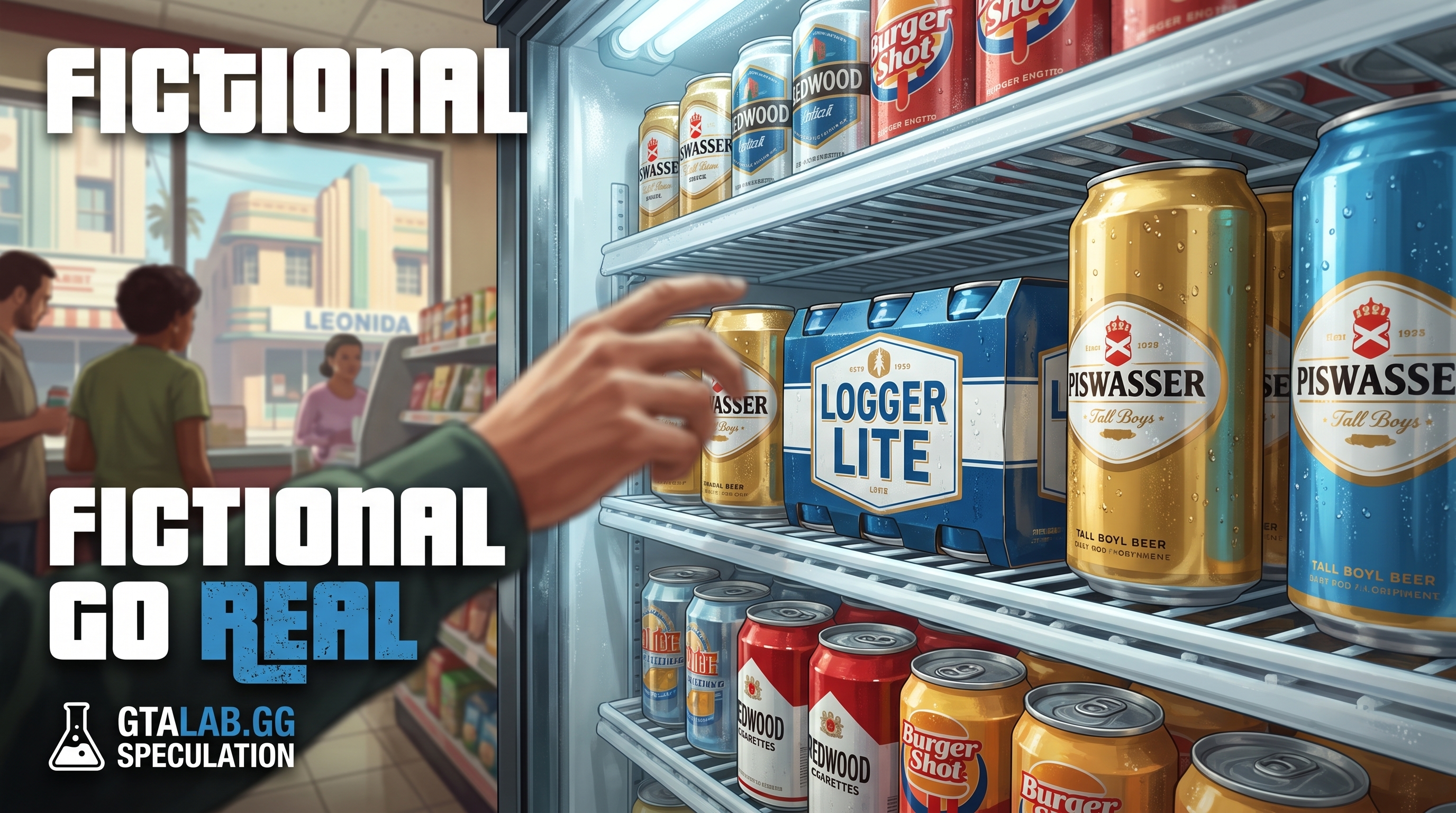
Rockstar has long populated its open worlds with satirical stand-ins for real consumer goods. GTA 6 is no different — Leonida's convenience stores, dive bars, and roadside diners are stocked with fictional beer labels designed to feel lived-in and regional, the kind of sun-faded six-pack you'd grab at a Florida gas station.
The step change in 2026 is that at least some of those GTA 6 beer brands are being produced as genuine consumer products — physical cans or bottles tied to the Leonida fictional universe. IGN reported on the development, framing it as part of Rockstar's aggressive real-world marketing expansion surrounding the November 19 launch.
Specific brand names from in-game have not all been officially catalogued yet, but Rockstar's wider product strategy makes the intent clear: the game world and the real world are being deliberately blurred.
This Isn't the First Time Rockstar Played This Game
The precedent exists, but it was always smaller in scale. Cast your mind back to GTA IV and the Liberty City brand universe — Pisswasser beer, a recurring in-game lager, became a real promotional product for a limited window around that era. Players could order branded merchandise. The joke was the product; the product was the joke.
Red Dead Redemption 2 pushed further. Rockstar's whiskey tie-ins and general merchandise around RDR2's launch were more polished, more intentional. But they still read as *novelty* — collector's items for the devoted fanbase, not mainstream consumer goods.
GTA 6's Leonida beer play feels categorically different. It's not a joke product for fans. It's a brand extension designed to sit on a shelf next to actual beer.
The $400 Collector's Box: Context for the Scale of This Push
To understand the beer brand move, you need to understand the full scale of what Rockstar is doing around GTA 6's launch. The Grand Theft Auto 6: The Good Time State — Vice City Collection — a premium collector's set priced at $400 — doesn't even include the game. It's pure merchandise: physical maps, branded objects, lifestyle products rooted in the Leonida aesthetic.
Fans pushed back hard. Comparisons to Red Dead Redemption 2's collector's edition spread quickly, and the consensus online was blunt: $400 for a box without the game crosses a line. But the outrage itself validates the strategy's ambition. Rockstar is treating GTA 6 not as a game with some merch on the side, but as a brand platform — one where the game is the anchor, not the ceiling.
The fictional beer brands fit neatly into that architecture. They're not promotional afterthoughts. They're SKUs in a lifestyle ecosystem.
The Miami Heat Partnership: How Deep the Real-World Integration Goes
The beer brands don't exist in isolation. Rockstar secured a deal with the Miami Heat for a Vice City-themed NBA game in November 2026 — the Heat wore GTA 6-branded uniforms on a specially designed court against the Milwaukee Bucks. That's not advertising. That's co-branding at a major sports league level.
Add to that the reported live-action trailer shoot in Miami — eagle-eyed fans spotted production convoys and camera crews staging what appeared to be a high-budget, real-location Rockstar production — and a picture emerges: Vice City/Leonida as a real cultural location, not just a game setting.
Beer brands that reflect that same Miami-meets-Florida-kitsch aesthetic aren't a stretch. They're the logical consumer product extension of a world Rockstar has spent millions making feel tangible.
What This Model Actually Is — And Why It Matters
Let's be precise about what Rockstar is doing, because it's easy to mistake this for conventional game merchandising. It isn't.
- Traditional game merch: T-shirts, figurines, art books. Items that signal fandom. Sold to existing fans.
- Rockstar's Leonida strategy: Consumer goods that can reach non-players. A can of Leonida beer on a bar shelf markets the game to people who haven't bought it yet.
That second point is the key. A real product with in-game branding is a billboard that pays for itself. The person who buys a six-pack of a GTA 6 fictional beer label — even as a novelty — is now a walking advertisement. Their friends ask about it. The label gets photographed. The brand name circulates outside the game's existing audience.
This is what makes it a genuinely new model for game IP monetization, not just a bigger version of the old one.
The Immersion Argument: Does This Help or Hurt the Game World?
Here's the tension Rockstar has to manage carefully. GTA's fictional brands have always worked *because* they're satirical. Pisswasser is funny. A fake beer label on a real can, sitting next to actual craft IPAs at a bottle shop, risks losing the irony entirely.
There are two ways this plays out:
- Best case: The in-game brands are so richly detailed and culturally specific to Leonida that holding one in real life deepens the player's connection to the world. The beer becomes a prop in a game you live in, not just play.
- Worst case: The satirical edge gets sanded off in the translation to a real retail product, and the brand becomes generic novelty merchandise — amusing for a week, forgotten by month two.
The historical record suggests Rockstar knows which side of that line to stay on. But the $400 collector's set backlash is a reminder that every extension of a beloved world carries trust capital risk. Get it wrong, and you don't just lose a product — you damage the brand underneath it.
Comparing the Fictional-to-Real Brand Pipeline Across Gaming
| Game / Studio | Fictional Brand | Real-World Extension | Scale |
|---|---|---|---|
| GTA IV (Rockstar) | Pisswasser Beer | Limited promo product (est.) | Small / fan-facing |
| Red Dead Redemption 2 (Rockstar) | Various whiskey/goods | Collector's merch | Medium / enthusiast |
| Cyberpunk 2077 (CD Projekt Red) | Samurai band / Night City brands | Clothing collabs, energy drinks | Medium / retail |
| GTA 6 / Leonida (Rockstar) | Leonida beer brands | Retail consumer product | Large / mainstream (est.) |
No studio has yet pushed a fictional in-game consumer brand all the way to mainstream retail at this scale. If the Leonida beer products land in standard retail channels — not just the Rockstar Warehouse — this is genuinely new territory.
What This Means for GTA 6 and the Industry
For GTA 6 specifically: Leonida merchandise and real-product brand deals represent a revenue layer that exists entirely outside game sales, DLC, and GTA+ subscriptions. That matters to Take-Two Interactive's financials, especially given the scale of GTA 6's development cost.
For the industry: studios watching this launch will be taking notes. If Rockstar demonstrates that a game's fictional brand ecosystem can generate genuine consumer goods revenue and cross-market to non-players, the template will be borrowed — fast. Expect competitors to audit their own in-game brand assets with new eyes by 2027.
The honest assessment: this is smart, but it's not risk-free. Rockstar's fictional worlds are beloved precisely because they feel autonomous — not extensions of a marketing department. Every real-world product carries the potential to make Leonida feel less like a place and more like a campaign. The line between world-building and brand-building has never been thinner.
FAQ
Q. Are GTA 6 beer brands actually real products you can buy? Yes — reports from 2026 confirm that at least some of GTA 6's fictional Leonida beer brands are being produced as real consumer products, not just in-game assets. Specific retail availability details are still emerging.
Q. Has Rockstar done this kind of thing before with GTA? On a smaller scale, yes. GTA IV's Pisswasser beer and Red Dead Redemption 2's merchandise were early versions of this approach, but they were aimed at existing fans rather than mainstream retail consumers.
Q. What other real-world GTA 6 marketing has Rockstar done? Rockstar partnered with the Miami Heat for a Vice City-themed NBA game with custom uniforms and a specially designed court. Reports also indicate a high-budget live-action production was filmed in Miami around the launch period.
Q. Does buying GTA 6 Leonida merchandise come with the game? No. The $400 Vice City Collection collector's set — Rockstar's most expensive official merchandise bundle — does not include a copy of GTA 6 itself, which drew significant criticism from fans.
Q. Why does turning fictional GTA brands into real products matter for the game industry? It represents a new IP monetization model where a game's fictional consumer brands generate real retail revenue and market the game to non-players simultaneously — a pipeline no major studio has executed at this scale before.