
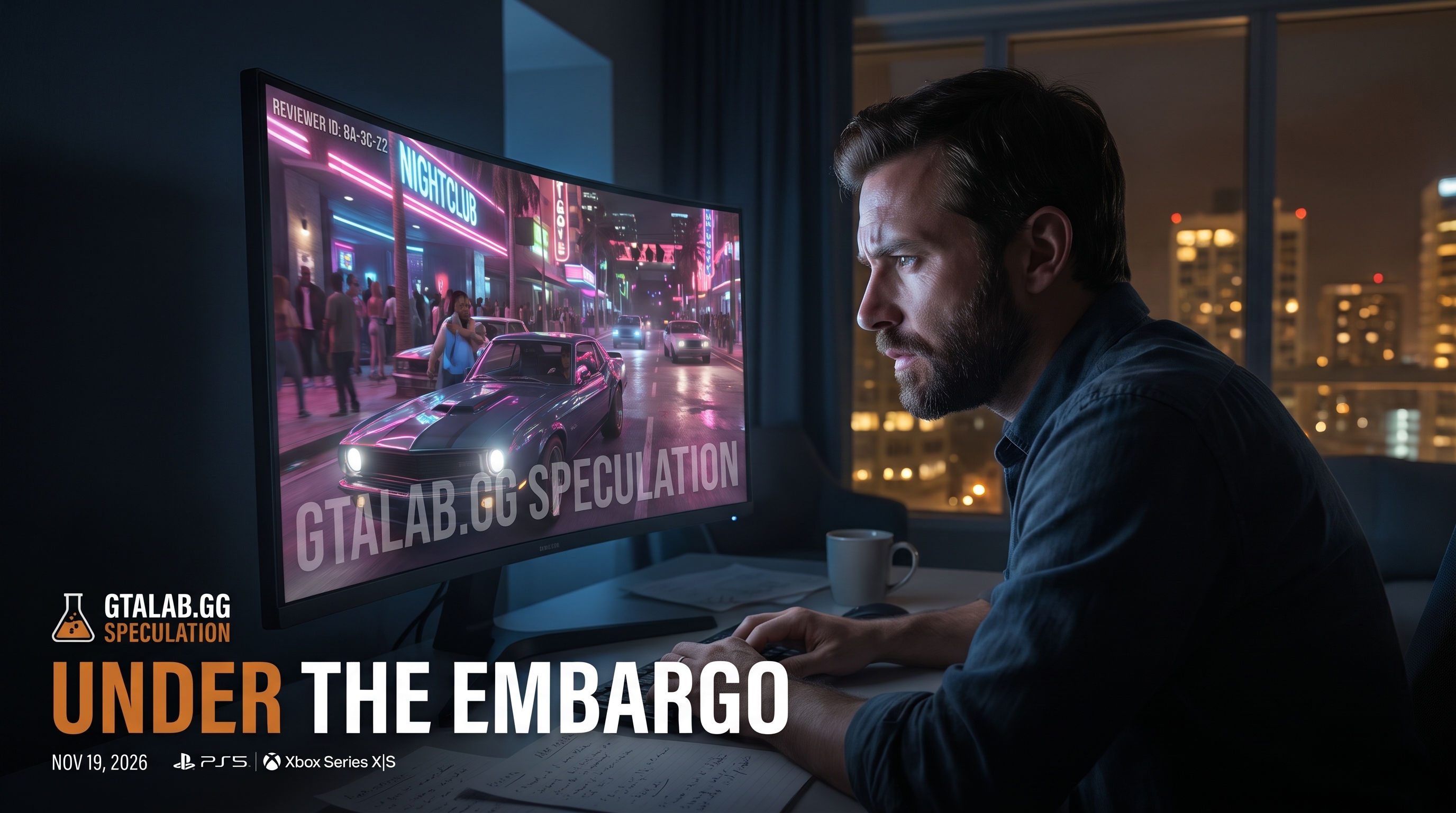
Rockstar Games is not leaving review security to chance. According to multiple social media reports circulating in mid-2026, every GTA 6 review copy sent to press comes embedded with a unique watermark — and the reviewer's name flashes persistently on screen throughout gameplay. The goal is straightforward: make unauthorized distribution traceable before it happens.
That's the confirmed shape of the story. What deserves closer scrutiny is the gap between "unprecedented security measures" headlines and what those measures actually mean in practice — for journalists, for the GTA 6 review embargo timeline, and ultimately for you as a consumer trying to plan around a November 19, 2026 launch.
What Is Actually Confirmed vs. What Is Rumored
| Claim | Status | Source |
|---|---|---|
| Unique watermarks embedded in each GTA 6 press review copy | Rumored / Unverified | Social media reports (Instagram, Facebook gaming pages) |
| Reviewer name flashing on screen during gameplay | Rumored / Unverified | Same social media circuit |
| Rockstar sending review copies roughly 3 weeks before launch | Estimated (est.) | Pattern from Red Dead Redemption 2 / GTA V press cycles |
| Official Rockstar statement on GTA 6 review security measures | Not confirmed | No public announcement as of publication |
Treat any headline claiming Rockstar has confirmed these measures as incomplete until it traces back to an official Rockstar or Take-Two statement. The watermark reports come from gaming social media aggregators — credible as a signal, not as a verified fact.
Why Watermarking Review Copies Is Actually Standard — Just Not at This Scale
Forensic watermarking in entertainment is not new. Film studios have embedded invisible metadata into screeners for years. The twist here is the visible, persistent on-screen flash of a reviewer's name — a far more aggressive approach than a hidden pixel signature.
If accurate, this tells you something important about Rockstar's threat model. The company isn't just worried about traditional press leaks. It's worried about footage — screen-recorded clips, YouTube shorts, social media spoilers — reaching audiences days or weeks before launch. A visible watermark is a deterrent, not just a forensic tool. You can't crop it out cleanly. You can't blur it without making the blur itself the story.
The Irony: Spoiler YouTubers May Have Received Copies Too
Here's the part that cuts against the "unprecedented lockdown" narrative. Multiple reports suggest that some content creators with a history of GTA spoiler coverage were also included in the review distribution. If that's accurate — and it remains unverified — it raises an obvious question: what exactly is the security perimeter protecting?
The most charitable reading is that Rockstar's watermarking system is specifically designed for this scenario. If a spoiler drops, the name-flash makes the source instantly identifiable. The watermark becomes the enforcement mechanism. It doesn't prevent the leak; it guarantees the leaker is caught. That's a different kind of security — deterrence over prevention.
What "Extreme Measures" Actually Looks Like in a GTA 6 Press Review
Beyond watermarking, previous Rockstar review embargoes have included controlled review environments (journalists playing on-site rather than at home), hardware restrictions, and communication blackouts during the review period. None of those specifics have been confirmed for GTA 6 yet.
What's been reported for this cycle breaks down into two categories:
- Technical controls: Per-copy unique watermarks, persistent reviewer name overlay during gameplay footage
- Legal controls: Standard NDA and embargo agreement, breach consequences tied to watermark identification
What has not been confirmed: mandatory on-site review sessions, internet-restricted consoles, or hardware surrender at the end of the review period. Those measures exist at the extreme end of industry practice — but there's no credible report placing them in GTA 6's review framework as of now.
The 3-Week Review Window: What the Timeline Means for You
Based on Rockstar's historical pattern — Red Dead Redemption 2 went out roughly three weeks before its October 2018 launch, with embargo lifting within 24 hours of release — a similar cadence for GTA 6 would put review copies in press hands around late October 2026 (est.), with embargo lifts landing close to launch day, November 19.
That timeline matters for consumers. Here's what it means in practice:
- Pre-orders before reviews: If embargo lifts within 24–48 hours of launch, anyone who pre-ordered is essentially making a blind purchase. That's a deliberate Rockstar decision, not an accident.
- Review scores land at launch, not before: Metacritic aggregation won't help you decide whether to spend $80–$100 (depending on edition and region) until after the street date.
- First-week impressions will dominate: Expect the conversation to be shaped by launch-day social media and streamer reactions faster than traditional critic reviews — which plays directly into why watermarking footage matters so much.
Why Rockstar's Security Posture Is Different From Other Publishers
Most AAA publishers send review copies 1–2 weeks out with a standard NDA. A few high-profile titles — The Last of Us Part II, Cyberpunk 2077 — became case studies in embargo strategy after leaks or compressed review windows drew criticism.
Rockstar's position is structurally different for three reasons:
- Scale: GTA 6 is the single most anticipated game release in industry history by most commercial metrics. The spoiler surface area is enormous.
- Story dependency: Unlike a multiplayer-first title, GTA 6's value proposition is heavily narrative. A story spoiler before launch is a genuine product harm, not just bad PR.
- The 2022 precedent: The massive GTA 6 development footage leak in September 2022 — over 90 clips from an early build — was a reputational and operational disaster. Rockstar is not going through that again if it can help it.
Persistent on-screen watermarks are a direct response to that 2022 event. Phone-recorded screen footage was the leak vector. A name-stamped overlay makes that vector expensive to use.
What Journalists Are Actually Dealing With
For working games journalists, aggressive GTA 6 review security measures create real practical challenges. Writing a review of an open-world game this large — set across a fictionalized Miami and surrounding areas, with a reported campaign length well above 40 hours (est.) — under a compressed embargo window requires prioritization decisions that shape what the review actually covers.
If reviewers can't capture their own clean footage, they're working from either memory or official press assets. That's a limitation that readers rarely see disclosed, but it affects the texture and specificity of reviews. A critic describing a mission sequence from memory writes differently than one who can re-watch a clip.
The honest answer is that Rockstar's security measures serve Rockstar's interests first. They also, secondarily, protect the experience for players who want to go in unspoiled. Those two things can both be true.
What to Watch For as Launch Approaches
The next credible signal will be when journalists publicly acknowledge receiving review hardware — or when Rockstar issues any official communication about press access. Until then, the watermark reports should be filed under highly plausible, unconfirmed.
If review copies go out in late October as expected (est.), you should anticipate:
- An embargo lift date announced alongside copy distribution (Rockstar controls this precisely)
- Reviewer social media going quiet on GTA 6 specifics for 2–3 weeks
- Any footage that surfaces before the embargo lifts being aggressively flagged — and now, potentially traceable
The watermark system, if real, doesn't just protect against leaks. It changes the risk calculation for anyone thinking about posting early footage. That's by design.
FAQ
Q. What is the GTA 6 review embargo, and when does it lift? Rockstar has not officially announced an embargo lift date. Based on historical patterns from Red Dead Redemption 2, review copies are expected to go out roughly three weeks before the November 19, 2026 launch, with embargo lifting close to or on release day (est.).
Q. Are the GTA 6 review copy watermarks confirmed by Rockstar? No. As of publication, the watermark and flashing reviewer name reports come from social media aggregators, not from Rockstar Games or Take-Two Interactive directly. Treat them as credible but unverified.
Q. Why does Rockstar use such aggressive GTA 6 review security? The 2022 GTA 6 development footage leak — over 90 clips from an early build — was a major factor. Persistent on-screen watermarks make phone-recorded screen footage traceable back to a specific reviewer, raising the cost of leaking dramatically.
Q. Will GTA 6 reviews be available before launch day? Unlikely, based on Rockstar's historical embargo strategy. Embargo lifts for major Rockstar titles typically land within 24 hours of the street date, meaning most consumers will not have access to review scores before the game releases.
Q. What does the GTA 6 press review process mean for consumers deciding whether to pre-order? It means pre-ordering GTA 6 is effectively a purchase made without critical review access. If you're waiting for scores before committing, the current embargo pattern suggests that window will be very short — possibly less than 24 hours before launch.