
The honest answer first: Rockstar isn't ignoring American politics because it's gone soft. It's making a deliberate creative choice — and GTA 6 writer Rupert Humphries has been unusually candid about what that choice is. Instead of pointing the camera directly at Trump, MAGA rallies, or whatever dominated last week's news cycle, the studio is building a heightened, exaggerated version of Florida itself. That's the satire target. Not a politician. A culture.
That distinction matters more than it might look. It defines every character archetype, every radio DJ monologue, and every absurd side mission in Leonida.
What Rupert Humphries Actually Said
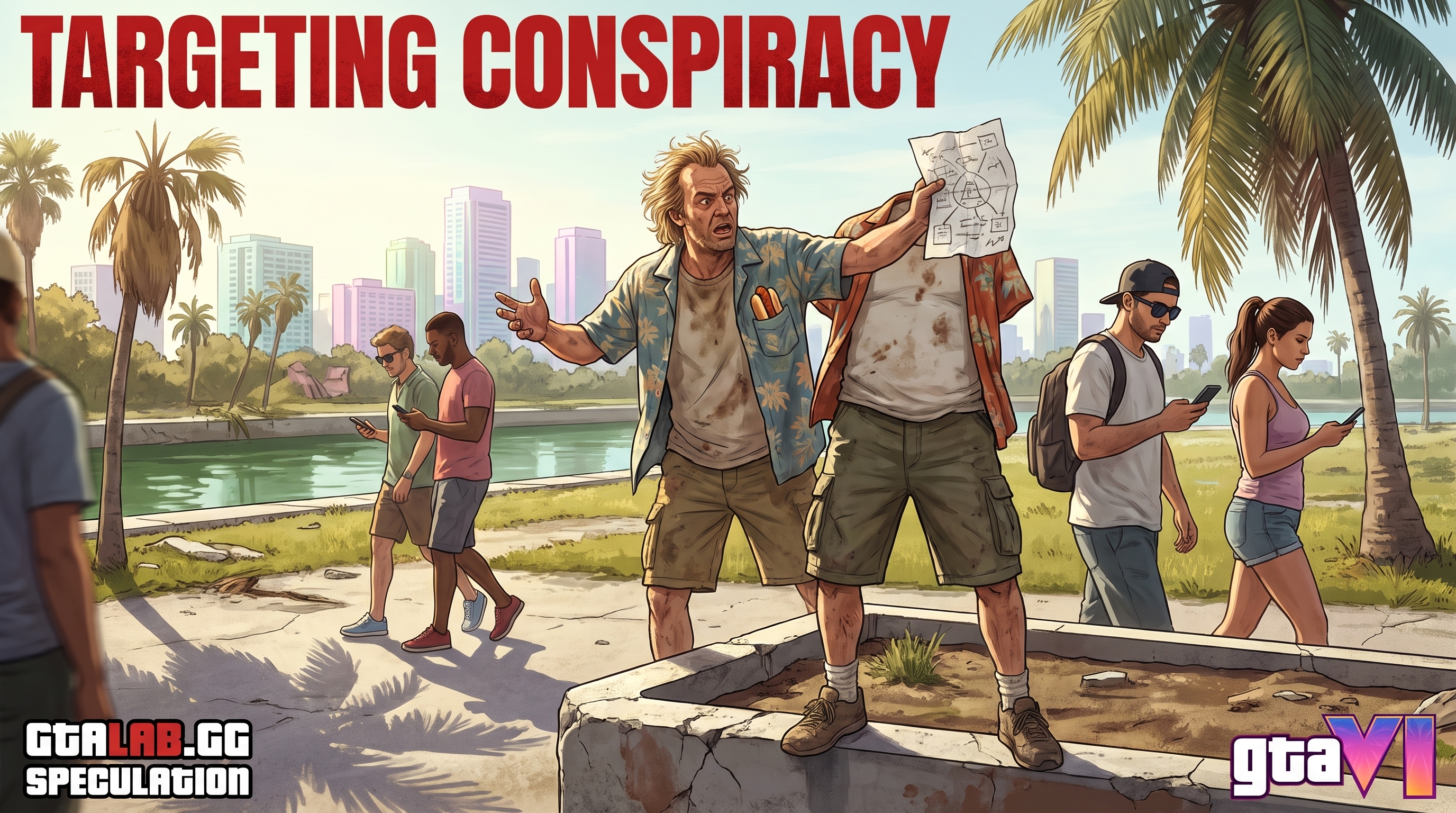
Humphries, a senior writer on GTA 6, stated in an interview that the writing team is deliberately steering away from satirizing specific figures like Donald Trump or movements like MAGA. His reasoning was direct: topical political targets date fast, and Rockstar builds games on decade-long timelines. A joke about a specific politician lands on launch day and becomes a history lesson by year three.
Instead, the team is focused on what Humphries described as the "conspiracy theory culture" and ambient social absurdity that Florida — and by extension, modern American life — generates at an industrial scale. The Sunshine State produces a specific flavor of chaos that is simultaneously real and unbelievable. That, he argued, is the more durable and more honest satirical target.
"We're not trying to make a comment on any specific political figure. We're trying to capture the feeling of a place." — Rupert Humphries (paraphrased from interview, confirmed source)
This is a philosophically coherent position — and historically, it's exactly how Rockstar's best satire has worked.
How GTA's Satire Has Evolved Since GTA III
Rockstar's approach to social commentary has never been uniform across the series. It has shifted with each generation — and understanding that arc makes the GTA 6 choice legible.
| Game | Primary Satire Target | Approach |
|---|---|---|
| GTA III (2001) | Crime movie genre conventions | Genre parody, broad strokes |
| GTA: Vice City (2002) | 1980s excess, Miami drug culture | Aesthetic satire, pop culture pastiche |
| GTA: San Andreas (2004) | Racial politics, police corruption, gang mythology | Character-driven critique, systemic targets |
| GTA IV (2008) | Post-9/11 paranoia, War on Terror rhetoric | Immigrant POV, ironic disillusionment |
| GTA V (2013) | 2008 financial crisis, celebrity culture, surveillance state | Three-protagonist structural critique |
| GTA 6 (2026, est.) | Florida conspiracy culture, social media spectacle | Ambient satire, culture over figure |
The pattern is clear. Rockstar's sharpest work targets systems and atmospheres, not individuals. GTA IV's Niko Bellic didn't skewer George W. Bush — he skewered the idea of America as seen through the eyes of someone who believed in it. GTA V didn't name specific bankers — it modeled the entire psychology of post-crisis wealth.
GTA 6 is following the same logic, one generation further.
Why "Florida Man" Is a Better Satire Target Than Any Single Politician
This is the creative argument Humphries is making, and it's worth taking seriously.
Satirizing Trump, or MAGA as a movement, creates an immediate problem: the target is already self-satirizing. A game that exaggerates Trump has to compete with actual Trump. A game that exaggerates a Florida man wrestling an alligator outside a gas station over a lottery ticket dispute — that has room to breathe. Rockstar can own that space entirely.
There's also a shelf-life problem. Games ship in 2026 and stay relevant for a decade. Political figures rise and fall. Florida's particular brand of ambient surrealism — the conspiracy theories, the off-grid preppers, the cryptid sightings filed alongside zoning complaints, the grifters running for city council on anti-chemtrail platforms — that culture is structural. It doesn't depend on any one election cycle.
Leonida, GTA 6's fictional Florida, is being built to capture that texture. Not to reference it. To become an exaggerated version of it.
What "An Exaggerated Version" Actually Means for Game Design
Humphries used the phrase "our own exaggerated version" of real-world culture deliberately. It's the same methodology Rockstar used with Los Santos (Los Angeles) and Liberty City (New York) — take a real place, identify its defining social pathologies, and amplify them until they're impossible to look away from.
For Leonida, that likely means:
- Radio and media satire focused on conspiracy content farms, wellness influencers selling prepper gear, and true-crime podcasts that spawn vigilante movements (est.)
- Faction design built around militia groups, MLM-adjacent criminal enterprises, and off-grid separatist communities rather than traditional mob families (est.)
- NPC behavior and ambient dialogue that reflects social-media-poisoned worldviews — characters who process every event through the lens of whether it'll go viral (est.)
- Lucia and Jason as protagonists who move through this world as insider-outsiders — close enough to the culture to know its codes, aware enough to find it absurd
These are estimates based on Humphries' stated philosophy and the design logic of previous GTA titles. Rockstar has confirmed the Leonida setting and the dual-protagonist structure. Specific quest content is unconfirmed.
Why This Approach Is More Politically Honest, Not Less
There's a counterargument worth acknowledging: some critics will read "we're not doing Trump jokes" as cowardice — an attempt to avoid controversy and maximize sales across the political spectrum. That's a fair concern to raise.
But the creative case runs the other direction. Direct political satire is often the laziest form of social commentary in games. It lets the audience feel clever for recognizing a reference without forcing them to examine themselves. "Ha, that guy is obviously meant to be [politician]" is a different cognitive experience from "wait, this entire town is organized around beliefs that I might actually hold a version of."
Rockstar's best work has always been more interested in the second experience. GTA V's Michael is not a satirical target who exists at a safe distance from the player. He is the player — the aging man who justified every compromise and is now surprised the world doesn't look the way he was promised. That cuts because it doesn't let you off the hook.
Leonida's conspiracy culture satire has the same potential. Florida Man is not a distant phenomenon. He is a recognizable feature of how a large portion of the internet processes reality in 2026. That's the material Humphries and the writing team are working with.
The Risk: Does Diffuse Satire Land?
There is a genuine creative risk in targeting a culture rather than a figure. Broad satire can become vague satire. GTA V's commentary on celebrity culture and surveillance occasionally lost focus because it was trying to hit too many targets at once.
For GTA 6 to succeed as social commentary, Leonida needs to feel specific. The absurdity has to be rooted in recognizable detail — the particular logic of a Florida county commission meeting, the exact rhetorical style of a local AM radio conspiracy show, the precise economic desperation that makes multi-level marketing schemes look rational. Generic "Florida weird" is a meme. Specific, observed Florida weird is literature.
Humphries' stated approach suggests the team understands this distinction. Whether the final game executes on it is a question we won't be able to answer until GTA 6 ships on November 19, 2026.
What This Means for Players Expecting Political Commentary
If you're loading GTA 6 expecting explicit MAGA jokes or a thinly veiled Trump character, you're going to miss the point — and possibly miss the actual satire happening around you. Rockstar is betting that ambient, structural commentary hits harder than a recognizable caricature.
The question worth sitting with before launch: Is the culture of conspiracy, spectacle, and viral absurdity something GTA 6 is critiquing from the outside — or is it something the game itself participates in? The best Rockstar titles have always blurred that line on purpose.
FAQ
Q. Why is Rockstar avoiding Trump and MAGA in GTA 6? Writer Rupert Humphries explained that targeting specific political figures dates quickly given games' long development and post-launch lifespans. Instead, Rockstar is satirizing Florida's broader conspiracy and absurdist culture, which it sees as a more durable and creatively richer target.
Q. What is GTA 6's satire actually focused on? According to Humphries, GTA 6's social commentary targets Florida's ambient conspiracy culture, social media spectacle, and the general surrealism of modern American life — systemic and cultural targets rather than individual politicians.
Q. How does GTA 6 satire compare to GTA IV and GTA V? GTA IV satirized post-9/11 paranoia through an immigrant's disillusionment with the American dream. GTA V targeted financial crisis culture and surveillance capitalism. GTA 6 continues that tradition of systems-level critique, shifting focus to social-media-era conspiracy culture and Florida as its primary lens.
Q. Will GTA 6's Leonida map reflect real Florida culture? Rockstar has confirmed the Leonida setting is a fictional version of Florida. Based on Humphries' stated philosophy, the world is being built as an "exaggerated version" of real Florida culture — amplifying its defining social textures rather than directly replicating specific real-world events or figures.
Q. When does GTA 6 release? GTA 6 is confirmed for November 19, 2026, on PlayStation 5 and Xbox Series X|S. A PC release date has not been announced.