
Rockstar Games has officially confirmed it. GTA 6 will simulate hurricanes, tropical storms, and a living ecosystem of more than 170 animal species inside the state of Leonida — a fictional recreation of Florida. The confirmation came through Game Informer's dedicated feature coverage, making this one of the few areas of GTA 6's design where we don't have to speculate. What the coverage did not do is explain how each layer connects to the next — how wind becomes a wave, how a wave changes your combat options, or why a panicking bird flock might be your first warning that a storm is incoming.
That's what this article is for. Below is a technical breakdown of every confirmed system, what we can reasonably infer from Rockstar's own track record (labeled est. throughout), and what remains genuinely unknown.
What Rockstar Actually Confirmed
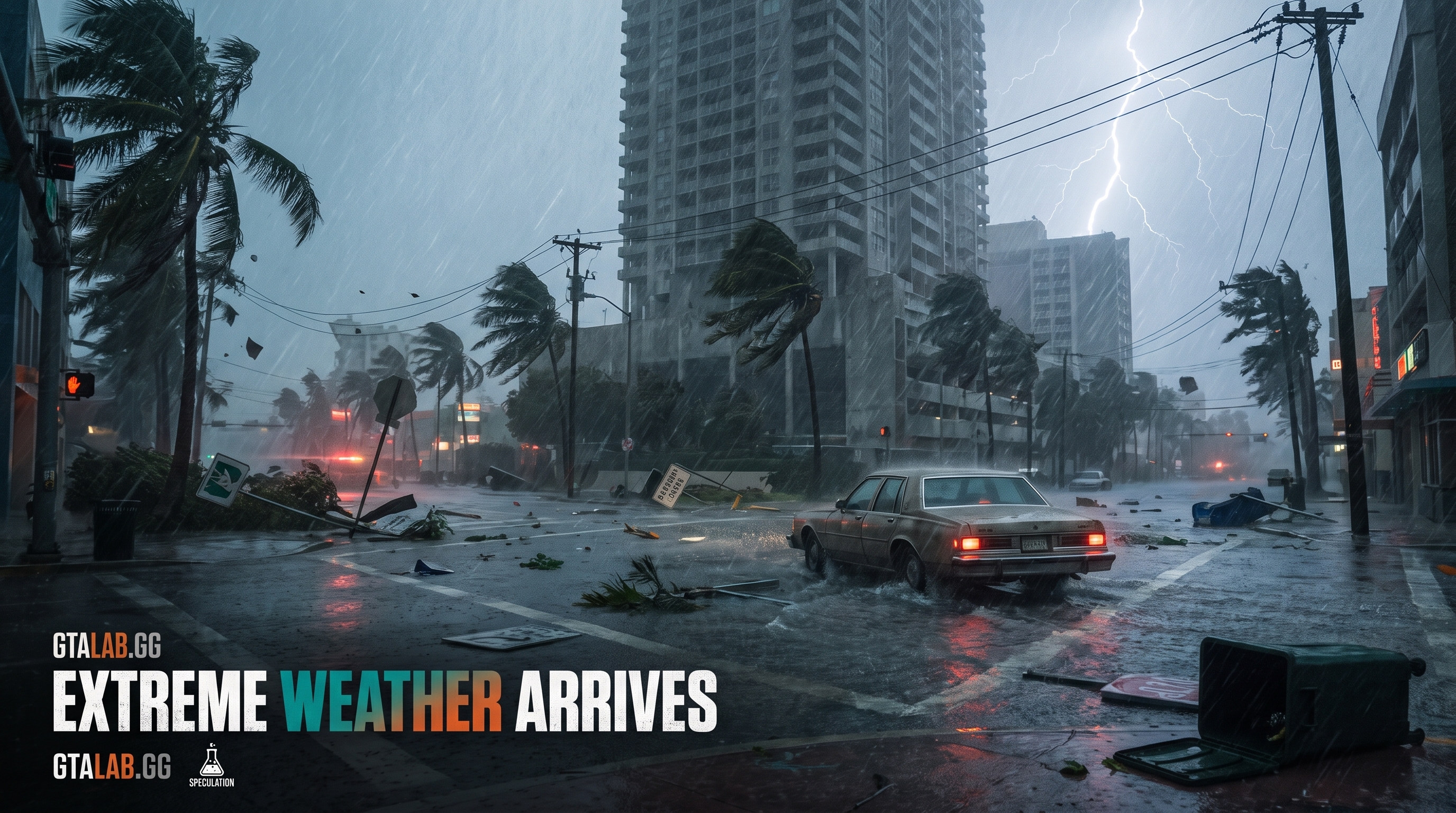
Before the analysis, the facts. Everything in this section is Confirmed — sourced directly from Rockstar's statements as reported by Game Informer's Issue 382 feature.
- Hurricanes and tropical storms are present in GTA 6's Leonida.
- The weather system is explicitly built around Florida's real climate conditions, including severe weather events.
- The system is described as an evolution of the one built for Red Dead Redemption 2 — Rockstar's most detailed weather simulation to date.
- Dynamic cloud formations move across the map in real time, producing different weather in different locations simultaneously.
- Rain creates persistent puddles and wet surfaces that remain after a shower ends. Rainbows can form.
- More than 170 animal species are present across land, air, and sea — approximately 60 bird species and 30 land mammals confirmed, with both native and non-native Florida fauna represented.
- A dynamic wind system is part of the simulation.
That is the confirmed foundation. Everything else below is analysis — either logical inference from those facts or labeled est. where it involves extrapolation.
How the Hurricane Simulation Likely Works — Layer by Layer
Layer 1: The Atmospheric Stack
Rockstar's RDR2 weather engine already modeled pressure-driven cloud behavior — clouds weren't just visual backdrops but responded to in-game weather state. GTA 6 takes that further. Game Informer's description of dynamic cloud formations moving across the map suggests a regional weather cell system, where each zone of the map carries its own atmospheric state.
In practice this means a hurricane doesn't just "spawn." It builds. You'd see distant anvil clouds thickening on the horizon before wind speed increases at ground level — the same visual sequencing Florida residents experience in real life. (est.) Whether Rockstar uses a full pressure-gradient simulation or a scripted escalation sequence is unconfirmed, but the result for the player should feel meaningfully similar.
Layer 2: Wind → Water Surface
The confirmed dynamic wind system is where things get physically interesting. Wind doesn't stop at the shoreline. In a properly coupled simulation, wind shear generates surface friction on open water, which builds into chop, then swell, then breaking waves. Given that GTA 6's Leonida includes extensive coastline, inter-coastal waterways, and open ocean — all confirmed from trailer footage — the wind-to-water pipeline matters enormously for nautical gameplay.
RDR2 already modeled rain hitting river surfaces with per-drop ripple physics. Scaling that to a hurricane-force wind event over open ocean would produce visually dramatic and mechanically punishing sea states. Boat handling in a tropical storm would be categorically different from calm-water navigation. (est.)
Layer 3: Surface Persistence
This one is explicitly confirmed: wet surfaces persist after rain stops. In gameplay terms, that means a road flooded during a storm doesn't immediately dry when the sun returns. Standing water affects traction. Storm drains can back up. Low-lying coastal areas — of which Florida has many — could remain partially inundated after a major weather event.
This persistence mechanic is a significant departure from GTA V, where weather was effectively cosmetic. In GTA 6, weather leaves marks.
The 170+ Animal Species: More Than a Number
What 170 Species Actually Means
Florida is one of the most ecologically diverse states in the continental U.S. — subtropical climate, Everglades wetlands, Atlantic and Gulf coastlines, and a long history of invasive non-native species (Burmese pythons, green iguanas, Nile monitor lizards). Rockstar's decision to include both native and non-native animals is a direct acknowledgment of that reality, and it suggests the ecosystem was built with some ecological literacy.
| Category | Confirmed Count | Florida Examples (est.) |
|---|---|---|
| Bird Species | ~60 confirmed | Pelicans, roseate spoonbills, ospreys, herons |
| Land Mammals | ~30 confirmed | Florida panther, black bear, manatee-adjacent |
| Marine / Aquatic | Unspecified | Sharks, dolphins, rays (est.) |
| Reptiles / Invasive | Unspecified | Alligators, pythons, iguanas (est.) |
| Total | 170+ confirmed | — |
Animal Behavior AI and Storm Response
Here's the part most coverage skips. 170 species is a roster count. What matters is how those animals behave — and whether that behavior connects to the weather system.
In RDR2, animals had schedules: predators hunted at dawn, prey species grazed in open meadows, birds roosted at dusk. The system wasn't just visual decoration — it was a living simulation layer. GTA 6's animal AI almost certainly inherits and extends this foundation. (est.)
The weather connection is where it gets tactically interesting. Real Florida wildlife responds visibly to incoming storms. Seabirds move inland. Coastal fish move to deeper water. Alligators can become unusually aggressive in rising flood conditions. If Rockstar has wired animal behavior to atmospheric state — and their track record suggests they would — animal behavior becomes a pre-storm indicator. A sudden mass movement of shore birds off the beach isn't just atmosphere. It's information.
Gameplay Implications: What Changes When a Storm Hits
Movement and Traversal
Wind-force weather physically impairs movement. High-speed driving on wet asphalt with crosswind becomes a handling challenge, not just a visual event. Motorcycles and lighter vehicles would be disproportionately affected. On water, small craft become nearly uncontrollable in hurricane-adjacent conditions — which opens interesting questions about whether certain coastal missions become physically impossible during active storm events, or simply much harder. (est.)
Combat and Visibility
Heavy rain and storm conditions reduce visibility range and degrade audio cues — both NPC awareness and player situational awareness. In a firefight, a thunderstorm suppresses gunshot sound carry and disrupts police response pathing. (est.) That's not a bug. That's a tactical variable a smart player will learn to exploit.
Mission and World Design
Rockstar confirmed the dynamic cloud system produces different weather in different map locations simultaneously. This means weather isn't a global toggle. You could be running from police in a clear-sky inland area while a tropical storm batters the coast thirty miles away. Whether missions are designed to force you toward storm zones — or let you avoid them — is unconfirmed. But the infrastructure is there.
How This Compares to the RDR2 Baseline
Red Dead Redemption 2 set the bar for Rockstar weather. Snowstorms reduced NPC density, forced NPCs indoors, and changed Arthur's thermal management needs. Rain affected tracking ability. Blizzards created genuine navigation hazards. GTA 6's system is confirmed to build on that engine — not replace it with something entirely new.
The meaningful upgrade is scale and severity. RDR2 had blizzards. GTA 6 has hurricanes. The physics demands of simulating a Category 1 or 2 hurricane on a densely populated urban coastline — wind-driven debris, storm surge, structural flooding — are orders of magnitude greater than a Rocky Mountain snowstorm. Whether Rockstar's engine handles that at full simulation depth or through selective rendering will determine how transformative the system actually feels in play. (est.)
What We Still Don't Know
Honesty requires this section. The confirmed details are exciting. The gaps are real.
- Storm frequency: How often do hurricanes and major tropical storms occur? Are they scripted to specific missions, random world events, or seasonal cycles? Unconfirmed.
- Player shelter mechanics: Does the game model taking cover indoors during storms, affecting wanted level or NPC behavior? Unconfirmed.
- Marine life behavior: The 170+ count likely includes significant aquatic species, but specific behavior AI for underwater fauna hasn't been described. Unconfirmed.
- Storm damage persistence: Do hurricanes leave lasting map changes — downed trees, flooded streets, structural damage — or does the world reset? Unconfirmed.
- Multiplayer weather sync: In GTA Online's successor, does every player experience the same storm simultaneously? Unconfirmed.
Treat any claim answering these questions definitively as speculation until Rockstar confirms them directly.
The Bottom Line
GTA 6's weather system isn't a feature checkbox. It's a simulation layer that touches physics, AI, traversal, combat, and ecology simultaneously. The confirmed details — hurricanes, 170+ animal species, persistent wet surfaces, dynamic regional cloud cells, and an explicit wind system — point to a world where weather is a gameplay actor, not a backdrop.
The honest caveat: we won't know how deep the simulation actually runs until November 19, 2026. But the infrastructure Rockstar has confirmed is the most ambitious weather architecture any open-world game has publicly committed to. That much is not in dispute.
FAQ
Q. Are hurricanes confirmed in GTA 6? Yes. Rockstar confirmed through Game Informer's Issue 382 feature that hurricanes and tropical storms are part of GTA 6's weather system, explicitly tied to Leonida's Florida-based climate design.
Q. How many animal species are in GTA 6? Rockstar confirmed more than 170 animal species across land, air, and sea — including approximately 60 bird species and 30 land mammals. Both native Florida wildlife and non-native invasive species are represented.
Q. How does the GTA 6 weather system affect gameplay? Confirmed details include persistent wet surfaces after rain, dynamic wind, and regional cloud systems producing simultaneous different weather across the map. The tactical implications for driving, combat visibility, and nautical handling are significant, though the full depth of gameplay impact is still being revealed ahead of the November 2026 launch.
Q. Is the GTA 6 weather system better than RDR2's? Rockstar confirmed GTA 6's weather builds directly on Red Dead Redemption 2's engine. The key upgrade is severity — RDR2 handled blizzards and thunderstorms; GTA 6 is confirmed to simulate full hurricanes, which represents a meaningfully higher simulation demand.
Q. Will animals in GTA 6 react to storms? Rockstar has not explicitly confirmed storm-responsive animal AI, but the combination of a confirmed dynamic weather system and confirmed animal behavior AI — inherited from RDR2's ecosystem model — makes weather-linked animal behavior a strong expectation. Treat it as (est.) until Rockstar states it directly.