
Every time Rockstar drops a new GTA 6 trailer, the internet splits into two camps within hours. One side is hyped. The other is convinced the game looks worse than it did before. The latest round of "GTA 6 downgrade" discourse is louder than usual — and this time, fans are coming with screenshots.
So let's do this properly. Is there an actual GTA 6 graphics downgrade between Trailer 1 and the most recent footage? Or is something else going on? Here's what the evidence actually shows.
Where Did the Downgrade Claim Come From?
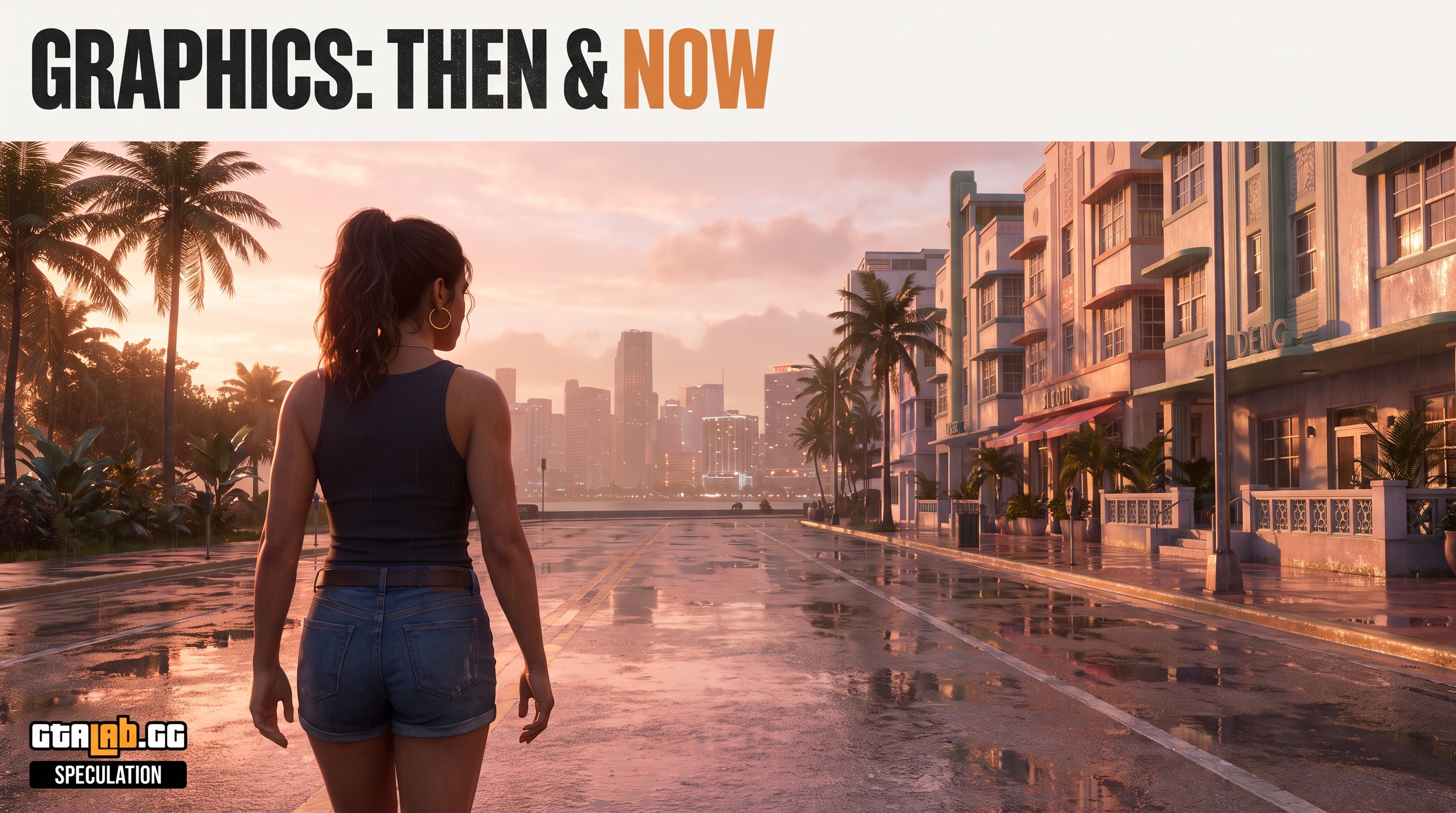
The pattern is familiar in gaming: a studio releases early footage that looks stunning, then later material appears softer, less detailed, or differently lit. Fans flag it, Reddit threads explode, and the word "downgrade" starts trending. It happened with Cyberpunk 2077. It happened with Watch Dogs. Now it's GTA 6's turn.
After the most recent trailer dropped — let's call it Trailer 3 for clarity — a significant portion of the community began doing side-by-side GTA 6 trailer comparisons with the December 2023 debut. The specific complaints center on a few recurring observations:
- Foliage and vegetation appear less dense in certain outdoor shots
- Water reflections look flatter compared to Trailer 1's coastal scenes
- Character skin shading seems less nuanced in close-up sequences
- Ambient occlusion and shadow detail feel reduced in busy street scenes
- Overall image clarity looks slightly softer, as if resolution or sharpening changed
Those observations aren't imaginary. But the cause matters enormously — and the community is skipping straight to the worst-case conclusion.
The Honest Answer First
No official source has confirmed any graphical downgrade. Rockstar has not commented. Take-Two has not commented. Everything in this conversation is fan-led comparison, which makes it — by definition — rumor and analysis territory, not confirmed fact.
With that labeled correctly, let's actually look at what could explain the differences.
Technical Reason #1: Compression and Encoding Are Doing Most of the Work
This is the part most of the discourse skips entirely.
When Rockstar uploads a trailer to YouTube, the video goes through aggressive lossy compression. YouTube re-encodes everything — often multiple times across different quality tiers. Fine details like individual leaves, subtle specular highlights on wet pavement, and the micro-detail in skin shading are exactly the kind of information that H.264/H.265 compression destroys first. It's not random. These are high-frequency details that compression algorithms deprioritize in order to hit file size targets.
Trailer 1 landed in December 2023 and has been viewed hundreds of millions of times. Over time, YouTube's CDN caches and serves optimized versions. More importantly, Trailer 1 had an enormous amount of community attention focused on finding the best quality captures — people were downloading 4K60 versions, frame-stepping, extracting lossless frames from the highest available bitrate source. The comparison screenshots circulating for Trailer 1 are often sourced from those optimized captures.
Trailer 3 is newer. The highest-quality community captures may not have propagated yet. If you compare a well-sourced Trailer 1 frame against a standard 1080p YouTube screenshot of Trailer 3, you are not comparing the same thing. You are comparing compression artifacts.
Technical Reason #2: Scene Selection Bias
The GTA 6 trailer comparison debate almost always picks the most flattering Trailer 1 shots and pairs them with the most problematic Trailer 3 shots. That's how the argument feels convincing — it is, structurally, a cherry-pick.
Trailer 1 had extraordinary lighting conditions: golden-hour Florida sunsets, highly stylized neon reflections at night, and slow panning shots that gave compression algorithms the best possible chance to preserve detail. Slower motion = more consistent frame data = better compression efficiency.
Trailer 3 appears to contain more action-heavy sequences: rapid camera cuts, fast vehicle movement, explosions, dense crowds. Motion-heavy scenes compress worse. A fast pan across a busy Vice City street will always look softer in a YouTube-compressed video than a slow cinematic glide over the ocean at dusk — even if both were rendered at identical fidelity.
Technical Reason #3: Lighting and Time-of-Day Choices
Real-time rendering looks radically different depending on lighting conditions baked into each scene. Direct sunlight at midday is the most demanding and most impressive scenario for rendering engines — it creates sharp shadows, crisp reflections, and visible material detail. Overcast or interior shots can look comparatively flat even at the same rendering quality level.
If Trailer 3 features more overcast environments, indoor sequences, or nighttime urban scenes under artificial light, it will look visually different from Trailer 1's saturated coastal palette — without a single polygon having been removed. Different is not the same as worse.
What Would an Actual Downgrade Look Like?
Real graphical downgrades — the kind that happened between pre-release footage and final product in some notable cases — have specific technical signatures:
| Indicator | Compression Artifact | Actual Downgrade |
|---|---|---|
| Foliage density reduction | Looks compressed/blurry, geometry unchanged | Fewer polygons/draw calls visible even in raw footage |
| Softer shadows | Fine shadow edges lost to encoding | Shadow map resolution visibly reduced in source |
| Reflection quality | Specular highlights flattened by compression | SSR/ray tracing switched off in all scenes |
| Crowd density | NPC count unclear due to motion blur + compression | Noticeably fewer NPCs in equivalent crowd shots |
| Texture detail | High-frequency detail washed out | Lower-res textures visible even in slow, clear shots |
The current GTA 6 downgrade claims do not consistently demonstrate the right-column signatures. What the comparison screenshots show is largely consistent with the left column. That matters.
Is There Any Real Cause for Concern?
Honest answer: a small one, and it's not unique to GTA 6.
Games in late development frequently undergo performance optimization passes. Some visual settings get dialed back to hit stable 30fps or 60fps targets on console hardware. This is normal and expected — it happened to virtually every open-world title of this scale. The question is always degree, not whether it happens at all.
With GTA 6 launching November 19, 2026, Rockstar is presumably in final optimization and certification territory. It would be surprising if no LOD distances, shadow cascade counts, or vegetation draw distances had been adjusted since Trailer 1 was assembled — which was captured more than two and a half years before launch.
But here's the other side of that: Trailer 1 was almost certainly assembled from curated, cherry-picked engine captures as well. Marketing trailers are not raw gameplay. They are produced footage. The idea that Trailer 1 represented a stable, sustainable baseline that should look identical in later footage is, itself, an assumption worth questioning.
What Should You Actually Take From This?
Treat any headline reading "GTA 6 confirmed downgraded" as false until it traces to a verified, lossless technical comparison or an official statement. Right now, neither exists.
The GTA 6 graphics downgrade discourse is driven by real observations — some shots in the new trailer do look different from Trailer 1 fan-favorites. But "different" is doing enormous work in that sentence. Compression, scene selection bias, lighting conditions, and motion complexity explain the visible gap without requiring any actual reduction in the game's rendering capability.
When the game ships on November 19, 2026, and people have native 4K captures from console hardware — then the comparison will be meaningful. Until that day, we are comparing YouTube artifacts and calling it a graphics analysis.
That's the honest answer.
FAQ
Q. Is GTA 6 confirmed to have a graphics downgrade from Trailer 1? No. There is no official confirmation of any downgrade. The visual differences fans are pointing to are consistent with YouTube video compression, scene selection, and lighting differences — not verified reductions in rendering quality.
Q. Why do GTA 6 Trailer 1 and Trailer 3 look different? Several technical factors are at play: YouTube's lossy re-encoding removes fine detail, Trailer 3 contains more fast-motion sequences which compress worse, and different lighting conditions between scenes create a different look even at identical rendering settings.
Q. Do games always look worse in later trailers due to downgrading? Not always — but late-stage optimization passes are common for all large open-world games. Some visual settings get adjusted to maintain frame rate targets on console hardware. Whether GTA 6 has undergone meaningful changes can only be assessed from actual gameplay footage on retail hardware.
Q. When will we know for certain if GTA 6's graphics have been downgraded? Realistically, after launch. Once players have GTA 6 running on retail PS5 and Xbox hardware — currently scheduled for November 19, 2026 — direct comparisons with Trailer 1 footage will be possible using lossless capture tools.
Q. What is the fairest way to compare GTA 6 trailers for graphics quality? Use the highest available bitrate source for both trailers, compare scenes with equivalent lighting conditions and camera motion speed, and avoid pairing the strongest Trailer 1 shots with the weakest Trailer 3 shots. Most viral "downgrade" comparisons do not meet these basic standards.