
Rockstar didn't slow GTA 6 down by accident. According to reports surfacing ahead of the game's November 19, 2026 launch, the studio made a deliberate design decision to reduce the overall pace of gameplay — because the world is simply too detailed to rush through. That's the honest answer, and it splits the audience cleanly in two.
This isn't a rumor about missing features or a leak about cut content. It's a design philosophy choice, and understanding it changes how you should think about every trailer clip, every traversal sequence, every combat encounter you've seen so far.
What Does "Slowing the Game Down" Actually Mean?
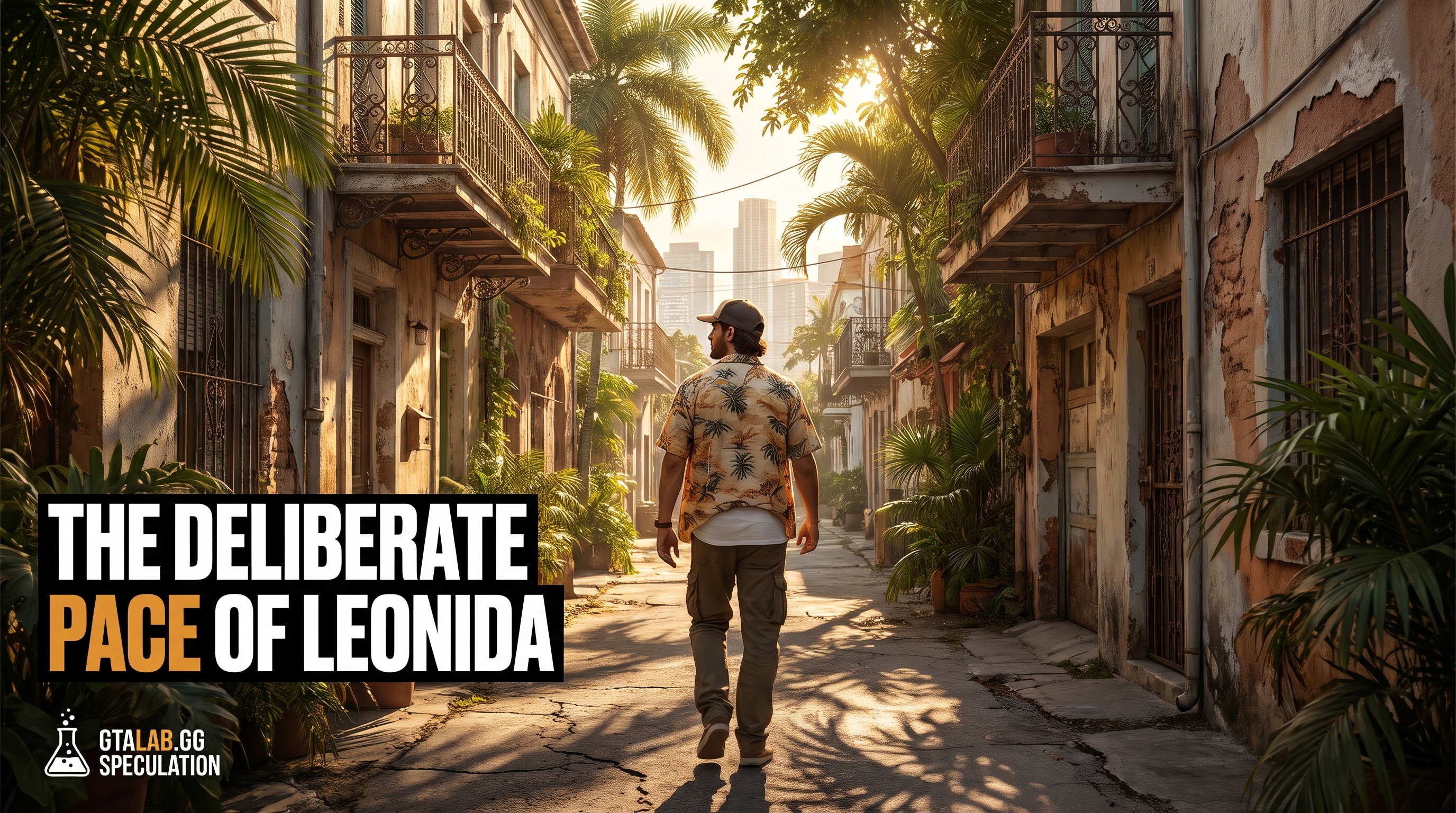
Let's be precise, because this phrase gets misused. "Slower pacing" in GTA 6 does not mean the game is boring, stripped of action, or artificially padded. It means Rockstar engineered the rhythm of play so that the world's density registers before the next event fires.
In GTA V, the pacing was aggressive by design. Missions escalated fast, traversal was frictionless, and the open world existed largely as a backdrop. Rockstar's own internal assessment — cited across multiple reports — was that GTA V's tempo actively caused players to skip past the open world rather than engage with it. You drove fast, triggered the next marker, moved on.
GTA 6's Leonida is built at a level of environmental fidelity that makes that approach self-defeating. If you can rush through it at GTA V speed, the detail investment becomes invisible. So Rockstar slowed the clock.
Three Places the Pacing Decision Shows Up
1. Combat Feel and Enemy Behavior
Combat in GTA 6 is reported to carry more weight per exchange. Enemies react with greater physicality, cover systems require more deliberate positioning, and the feedback loop between shot and consequence is longer than GTA V's arcade snap. This isn't just a visual upgrade — it's a pacing mechanism. Firefights take more time by design, which means you're spending longer inside each environment, absorbing it.
The risk is obvious: players who treat GTA as a pure power fantasy will feel friction where they expect flow. That friction is intentional.
2. Traversal and Movement Speed
On-foot movement in the trailers reads slower than GTA V's default. Lucia's animations carry weight — the way she moves through crowds, vaults obstacles, and transitions between states suggests Rockstar prioritized animation fidelity over responsive snap. Think RDR2's walking pace applied to an urban environment.
Vehicle handling is (est.) tuned similarly. Early impressions suggest cars feel more grounded — less the floaty, high-speed abstraction of GTA V and more the tactile, road-surface-aware handling that RDR2 applied to horses. You feel the road. You notice the neighborhood you're passing through.
3. Cutscene and Mission Transition Pacing
The trailers themselves offer a structural clue. Rockstar's GTA 6 cuts linger. Environmental establishing shots, character reaction beats, dialogue pauses — they're all longer than GTA V's equivalent moments. This isn't poor editing. It's a signal about how missions will be paced: less immediate action handoff, more world-grounding between sequences.
Cutscene transitions in GTA V were almost aggressive in their speed — get in, deliver exposition, get out. If the trailers are representative, GTA 6 breathes differently.
Is This the RDR2 Philosophy All Over Again?
Yes — and that's worth sitting with, because the RDR2 comparison is not flattering to everyone.
Red Dead Redemption 2 is one of the most critically celebrated games ever made. It is also, by measurable player-hour data and Steam review patterns, a game that a significant portion of the audience bounced off of within the first ten hours. The deliberate slowness — the horse bonding mechanics, the camp chores, the two-second button holds — was either immersive world-building or padding depending entirely on who you asked.
Rockstar made that tradeoff consciously. They chose depth over breadth of appeal. And they appear to be making the same call with GTA 6.
The studio's reported internal logic: if GTA V's pace let players ignore the world, the solution isn't a bigger world — it's a slower one.
That's a coherent design argument. It also means GTA 6 will not be GTA V with better graphics. It will be a fundamentally different experience in terms of feel.
The RDR2 Slowdown: What the Data Actually Showed
| Design Element | RDR2 (2018) | GTA 6 (est. 2026) | Status |
|---|---|---|---|
| On-foot movement weight | Heavy, deliberate | Heavy, deliberate | Rumored / Trailer evidence |
| Combat lethality per hit | High | Higher than GTA V (est.) | Estimate |
| Vehicle/mount handling | Surface-aware, tactile | More grounded than GTA V (est.) | Estimate |
| Mission pacing | Slow build, long sequences | Slower than GTA V (est.) | Estimate |
| World detail density | Extreme | Extreme | Confirmed (trailer) |
| Deliberate friction as design | Yes (confirmed post-launch) | Yes (reported) | Rumored |
Who Does This Actually Divide?
The audience split on this decision falls roughly along two lines, and it's worth naming them clearly rather than pretending everyone will react the same way.
- Immersive / exploration players — This is Rockstar's stated target for GTA 6's pacing. If you finished RDR2's epilogue, read the in-game journal, and spent three hours just riding across the map listening to the ambient audio, slower pacing is a feature. You will feel rewarded.
- Action / mission-focused players — If you played GTA V primarily for heists, wanted tight mission design with minimal friction, and skipped RDR2 because it felt slow, GTA 6's pacing will create resistance. Not necessarily enough to ruin the game — but enough to feel.
Neither group is wrong. But Rockstar has clearly picked a side, and the action-first crowd should go in with adjusted expectations rather than assuming GTA 6 will feel like GTA V at higher fidelity.
What We Don't Know Yet
Here's the part they skip in most coverage: we don't have confirmed gameplay hours. We don't have confirmed mission structure data. We don't know if Rockstar has included optional pacing toggles (RDR2 eventually added a "cinematic mode" that at least changed how traversal felt). The reports about deliberate slowdown are credible and consistent — but they're not sourced from a Rockstar design document. They're inferred from trailer analysis, internal reporting, and the studio's own publicly stated philosophy on world engagement.
Treat any claim that "GTA 6 confirmed to be slower than GTA V" as an informed analysis, not an official statement. The shape of the evidence points clearly in one direction. The specifics are still (est.).
Why This Decision Makes Sense — and Where It Could Backfire
The argument for Rockstar's pacing choice is strong. A world built at RDR2-level fidelity deserves to be seen. Rushing players through it would be a waste of the investment — both Rockstar's and the player's. Slowing traversal, weighting combat, and breathing between cutscenes are all tools that make an environment feel real rather than decorative.
The argument against is equally serious. GTA's mainstream cultural footprint — the reason it sells 200 million copies across iterations — is built partly on accessibility and pace. GTA is the game your non-gamer cousin played at a party. It's approachable chaos. RDR2 was never that. If GTA 6's pacing gates that casual appeal behind deliberate friction, the long-tail player retention numbers will look different from GTA V's.
Rockstar knows this math. They've run it. The fact that they reportedly made the slowdown call anyway suggests they believe the immersive player base has grown large enough — or that the detail itself will carry the experience past the friction point. That's a bet worth watching.
FAQ
Q. Is GTA 6 confirmed to be slower than GTA 5? Not officially confirmed by Rockstar. Reports and trailer analysis strongly suggest a more deliberate pacing — heavier movement, weightier combat, longer cutscene beats — but no official design document has been published. Treat it as a well-evidenced estimate.
Q. Will GTA 6 feel like Red Dead Redemption 2 in terms of speed? Directionally, yes. Rockstar appears to be applying the same "deliberate friction as immersion" philosophy from RDR2 to GTA 6's urban setting. That means heavier on-foot movement and more grounded vehicles, though the overall tempo will likely be faster than RDR2 given GTA's genre expectations.
Q. Does slower pacing mean fewer action sequences? No. Slower pacing refers to the rhythm between and during sequences — not the absence of them. Combat, chases, and set pieces are all present. They're just designed to feel more consequential and less instantly resolved than GTA V's equivalent moments.
Q. When does GTA 6 release, and will there be a day-one patch addressing pacing? GTA 6 launches on November 19, 2026. Rockstar has not indicated any intent to patch or adjust base pacing at launch. Given that RDR2's deliberate slowness was a feature rather than a bug, a day-one reversal would be surprising.
Q. Is the pacing decision a problem for action-focused GTA fans? It depends on tolerance for friction. If GTA V's speed was part of what you loved, GTA 6 will feel different in ways you'll notice. If you can adjust expectations and treat the slower pace as a feature rather than a flaw, the world's detail density will likely win you over. That's the honest answer.