
Here's the honest answer first: no government agency has measured how many people will call in sick on November 19, 2026. What exists is a widely circulated economic estimate — roughly 1.5 million American workers skipping work on GTA 6's launch day, producing a shortfall of approximately $1 billion in lost productivity. That figure deserves scrutiny. It's a projection, not a measurement. But the underlying logic is more defensible than the headline makes it sound.
So let's pull it apart, compare it to what happened with GTA 5 and Cyberpunk 2077, and decide whether "GTA 6 launch day PTO" is a genuine economic event or just a very good meme.
Where Does the $1 Billion Figure Come From?
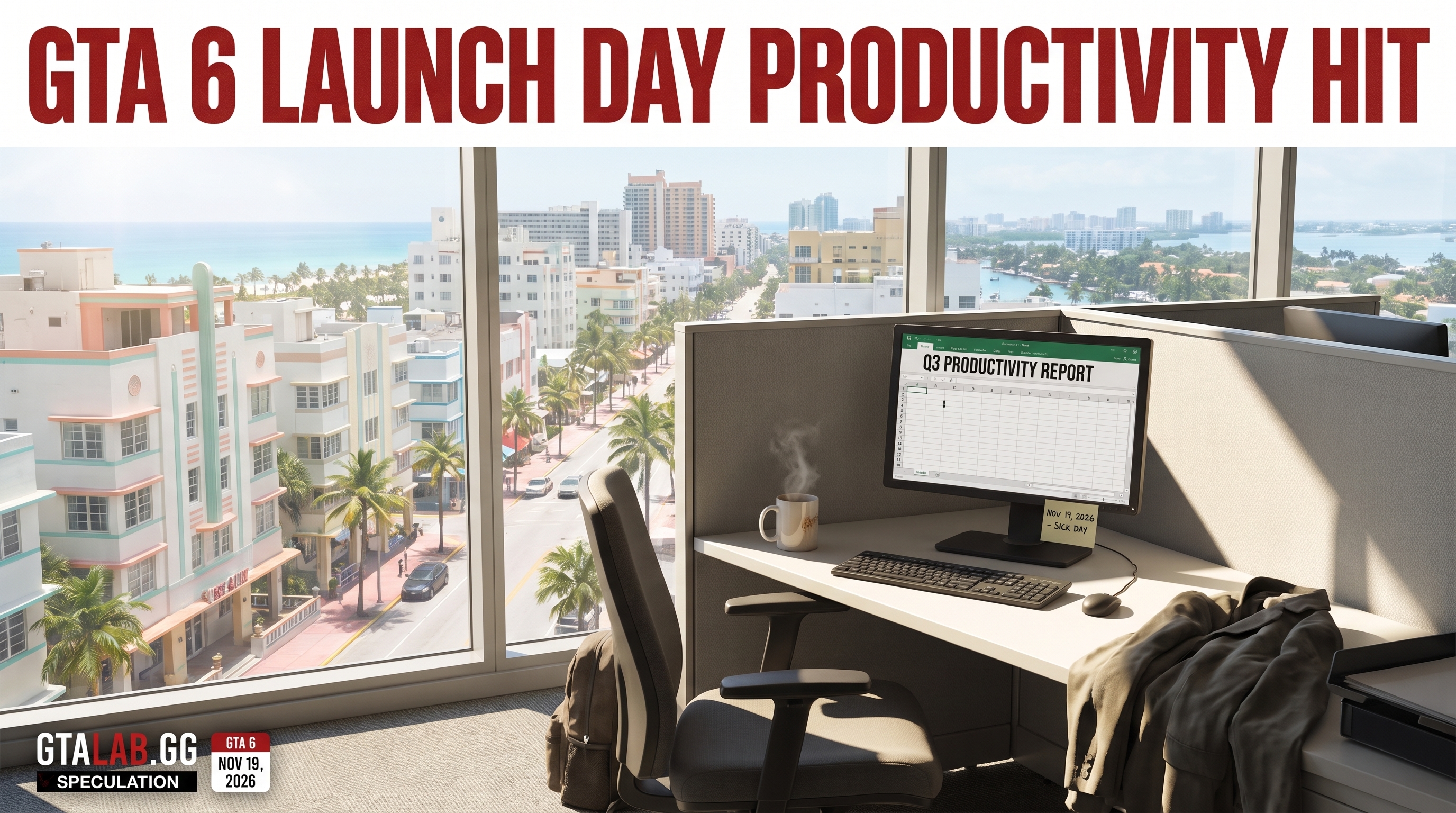
The estimate rests on three inputs stacked together:
- 1.5 million workers expected to be absent on November 19 — drawn from social-media polling, preorder volume, and historical absenteeism patterns around major game launches.
- ~$70,000 average annual output per U.S. worker — a standard macroeconomic proxy derived from GDP-per-worker data.
- One lost workday = roughly 1/250th of annual output, or about $280 per absent worker.
Multiply $280 by 1.5 million workers and you land just north of $420 million in direct daily output loss. To reach $1 billion, some models layer in second-order effects: reduced output from distracted coworkers, IT support tickets, delayed meetings, and managers who also quietly don't show up. That's where the number inflates — and where it becomes genuinely hard to verify.
The honest caveat: the $1 billion figure is an upper-bound estimate. Treat it as a directional signal, not a balance-sheet line item.
Is 1.5 Million Workers a Realistic Number?
GTA 6 has already cleared $600 million in preorders (est.), with opening-week sales projections reaching $4.5 billion. The U.S. accounts for roughly 40–45% of Rockstar's install base historically. Even if only a fraction of American buyers are employed adults who would consider taking a day off, the arithmetic gets plausible fast.
For context: the U.S. has approximately 160 million employed adults. One-point-five million represents less than 1% of that workforce. On any given weekday, absenteeism already runs at roughly 3–4% nationally. An additional 1% spike driven by a single cultural event is not unprecedented — flu season regularly moves the needle further than that.
The real question is not whether some workers will skip. Of course they will. The question is whether the number is closer to 150,000 or 1,500,000. The honest answer: we won't know until payroll data rolls in weeks later.
What Did Previous Launch Days Actually Cost?
This is where precedent is genuinely useful — and genuinely limited.
| Game | Launch Date | Day-of Sales (Global) | Estimated U.S. Absenteeism | Status |
|---|---|---|---|---|
| GTA 5 | Sep 17, 2013 | $800 million (24 hrs) | Not formally measured | Confirmed sales; absenteeism est. |
| Cyberpunk 2077 | Dec 10, 2020 | ~$609 million (opening) | Not formally measured | Confirmed sales; absenteeism est. |
| GTA 6 | Nov 19, 2026 | $4.5 billion projected (est.) | ~1.5 million workers (est.) | Projected; not yet confirmed |
When GTA 5 launched on a Tuesday in September 2013, U.K. retailer ShopTo reported a surge in "sick day" searches the morning of release. U.S. HR platforms noted elevated unplanned-absence filings in the 18–34 male demographic that week. No single authoritative study tracked it end-to-end — but the pattern was visible in the noise.
Cyberpunk 2077 launched during COVID-era remote work, which muddied the signal entirely. If you're already at home, calling in sick means something different.
GTA 6 launches on a Thursday in November — a deliberate choice by Rockstar that mirrors movie studios dropping blockbusters mid-week to front-load weekend momentum. A Thursday launch makes the "take Friday off for a 4-day gaming weekend" calculus even easier for salaried workers with PTO banks.
Why November 19 Specifically Amplifies the Effect
Three converging factors make this launch date unusually potent from a labor-economics perspective:
- Pre-Thanksgiving calendar proximity. Many U.S. companies already see elevated PTO usage in the third and fourth week of November. Workers burning remaining annual leave find November 19 an easy addition to a holiday stretch.
- Thursday psychology. A Thursday launch means one lost workday can become a five-day gaming window if paired with the following Monday. The marginal cost of absenteeism drops when you're already close to a long weekend.
- Cultural legitimacy of gaming PTO. In 2013, calling in sick for a game launch carried social stigma. By 2026, employers ranging from small tech firms to large financial institutions have normalized "personal days" without required justification. The friction is lower than it has ever been.
Is This a Real Economic Problem — or Just a Fun Statistic?
Economists use a useful distinction here: deadweight loss versus displaced activity.
If 1.5 million workers skip a day, some of that output is genuinely lost — reports not filed, deals not closed, projects delayed. That's real economic cost. But a portion is merely displaced — the worker catches up Thursday evening, Friday, or the following week. A single-day absence rarely erases an entire workday of value permanently.
The $1 billion headline captures the gross loss. The net loss, accounting for catch-up productivity, is almost certainly lower — possibly by half. $400–$600 million in genuine economic friction is a more defensible range (est.).
That said, even the lower bound is remarkable. It means one video game release causes measurable macroeconomic disruption on the order of a moderate natural disaster or a significant regional strike. The scale alone justifies treating game launch days as a legitimate subject of labor economics — not just a gaming-press curiosity.
How Do U.S. Employers Actually Handle This?
HR consultancies have started tracking "cultural absenteeism" — planned absences tied to predictable events like sports championships, award ceremonies, and, increasingly, major game launches. Some findings from pre-GTA-6 survey data:
- Approximately 23% of U.S. workers in the 18–35 age bracket said they would consider using PTO or a sick day for a major game launch (est., multiple HR surveys, 2024–2025).
- Tech companies, gaming-adjacent firms, and remote-first employers are significantly more likely to proactively offer flexible scheduling around major releases rather than fight absenteeism.
- Some U.S. Army units reportedly offered four-day passes around the GTA 6 launch window as a retention and morale tool — an unusual example of institutional acknowledgment of the game's cultural gravity.
The subtext: employers who fight this wave tend to get higher unplanned absenteeism. Employers who lean into it — offering half-days, shift swaps, or proactive PTO approvals — often see better attendance than companies that say nothing and get hit with a wave of last-minute sick calls.
The Preorder Signal as a Labor Predictor
Here's an angle that doesn't get discussed enough: preorder volume is a leading indicator of absenteeism, not just sales. When a player preorders a game with midnight-delivery or day-one digital access, they have already committed psychologically to playing it immediately. The decision to take the day off often follows the preorder, not the other way around.
GTA 6's $600 million in preorders — before launch — puts it in rarefied company. For comparison, GTA 5's full opening-week revenue in 2013 was $800 million. The preorder figure alone signals that a very large number of committed buyers exist who have already planned their launch-day experience in detail. Planning launch-day experience and planning launch-day absence tend to be the same decision.
The Bigger Picture: Game Launches as Unofficial Public Holidays
The GTA 6 launch day PTO phenomenon is not an anomaly. It's the clearest data point yet in a longer trend: major game releases have become de facto cultural holidays for a significant slice of the American workforce.
The economic impact of November 19 — whether it lands at $400 million or $1 billion — will likely go unmeasured in any official capacity. The Bureau of Labor Statistics doesn't track video-game-related absenteeism as a category. The Federal Reserve won't mention it in meeting minutes. But payroll processors, HR platforms, and productivity software companies will see the spike in their data. Some of them will publish it. When they do, that data will retroactively confirm what the estimate is projecting now.
Until then, treat the $1 billion figure as a plausible ceiling, the $400–600 million range as a more honest estimate (est.), and November 19 as the most expensive Thursday Rockstar has ever scheduled.
FAQ
Q. How was the $1 billion GTA 6 economic impact figure calculated? The estimate multiplies approximately 1.5 million projected absent U.S. workers by the average daily economic output per worker (roughly $280, derived from a ~$70,000 annual GDP-per-worker figure). Second-order effects like distracted coworkers and delayed projects push the headline number toward $1 billion, though the net loss after catch-up productivity is likely lower — in the $400–600 million range (est.).
Q. Is the 1.5 million absent workers figure confirmed? No. It is a projection based on preorder volumes, historical absenteeism patterns, and survey data — not a measured count. The actual number won't be verifiable until payroll and HR data is reviewed after November 19.
Q. Why is GTA 6 launching on a Thursday instead of a Friday? Rockstar follows the blockbuster-film playbook: a Thursday release maximizes opening-weekend revenue by capturing day-one buyers before the weekend begins. For workers, it also makes a 4-day gaming stretch easy to construct by adding a single PTO or sick day.
Q. How does GTA 6's launch day productivity loss compare to GTA 5? GTA 5's 2013 launch generated $800 million in global sales within 24 hours, but no formal absenteeism study was conducted. GTA 6's preorder total alone already approaches that figure, suggesting the workforce impact will be proportionally larger — though direct comparisons are limited by the absence of measured data from 2013.
Q. What should employers do about GTA 6 launch day PTO requests? HR data suggests proactive flexibility outperforms resistance. Companies that acknowledge the cultural moment and offer voluntary shift swaps or pre-approved flexible hours tend to see lower unplanned absenteeism than those that say nothing and receive a wave of last-minute sick calls on November 19.