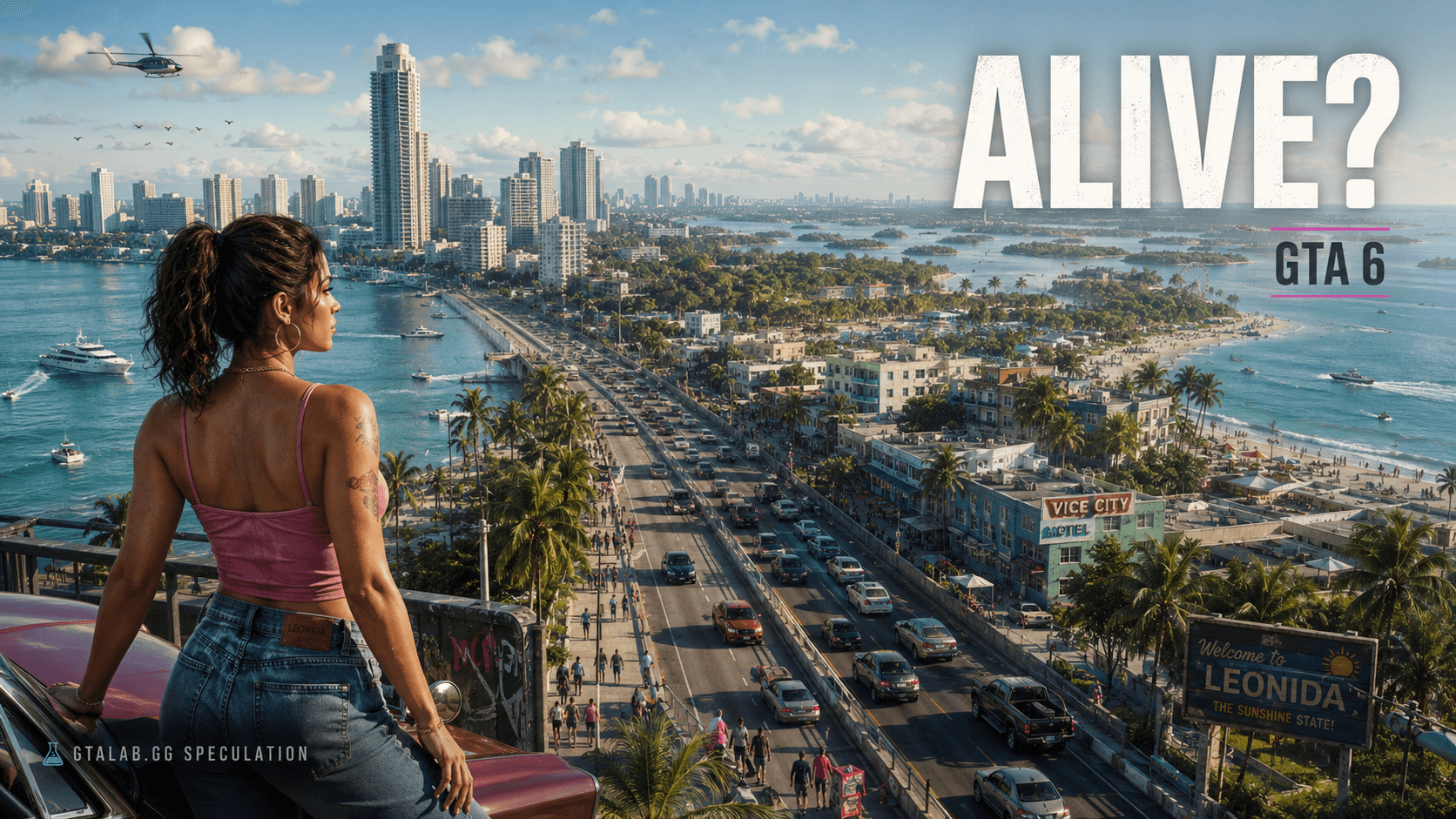
Bigger is not always better. That's the honest answer when someone asks whether GTA 6's reportedly massive Leonida map will actually be more enjoyable than GTA 5's Los Santos. The leaks and official footage confirm the scale is extraordinary — reportedly twice the landmass of GTA 5 and three times that of Red Dead Redemption 2. But the real question isn't how many square kilometers Rockstar built. It's how many of those kilometers are worth exploring.
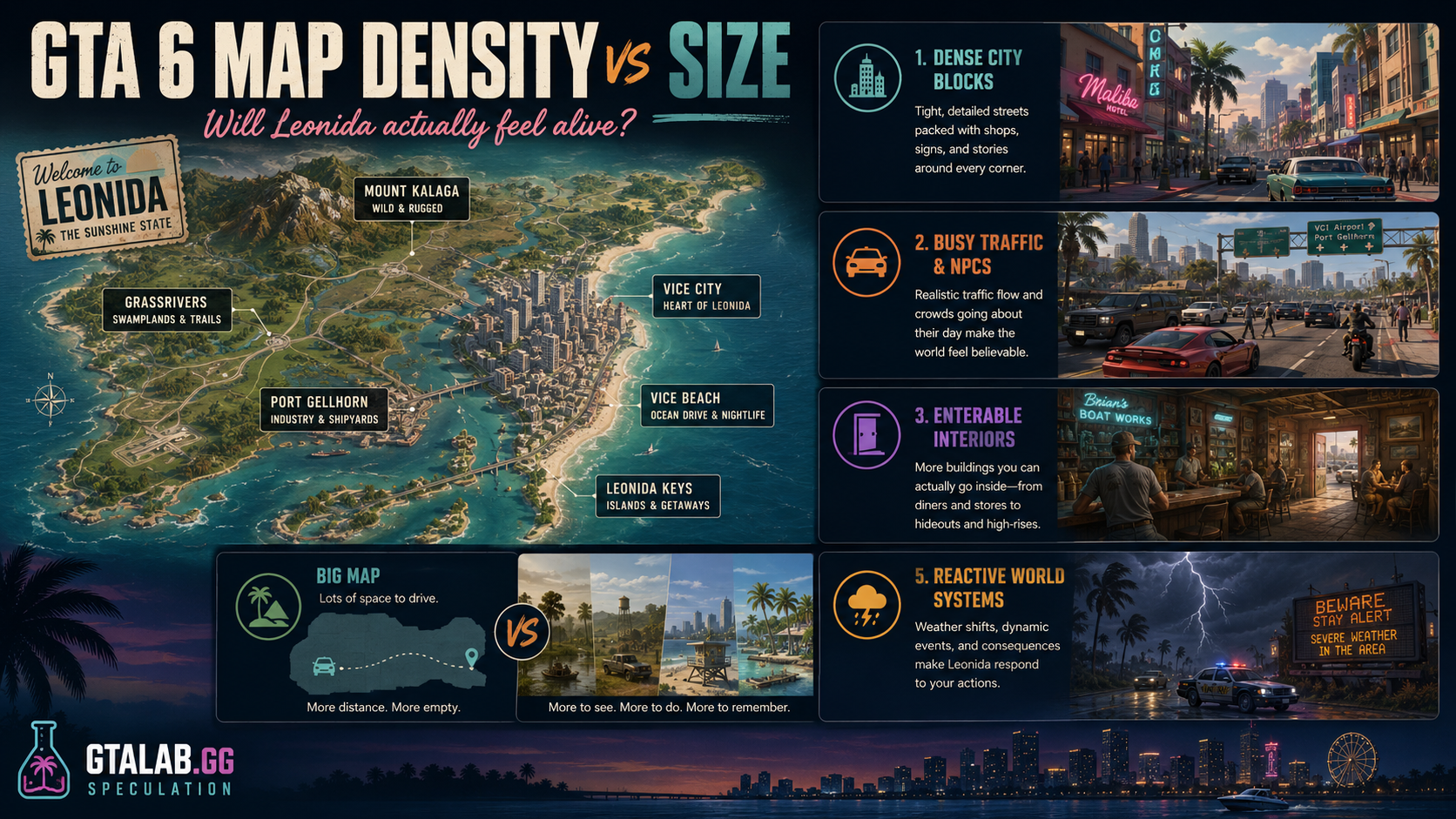
This is the conversation the map-size articles aren't having. GTA 6 map density — not raw acreage — will determine whether Leonida becomes one of gaming's great open worlds or a gorgeous, half-empty backdrop.
Why Map Size Is the Wrong Metric
Open-world games have been losing the size arms race for years. Players have learned, often painfully, that a bigger map can mean more of nothing. The problem isn't ambition. It's the gap between geometry and content.
Consider three reference points that matter here:
The Witcher 3: Wild Hunt — its map is roughly 136 km². Critics and players consistently rank it among the best open worlds ever made, not because it's vast, but because almost every corner holds a contract, a story, a secret. Content density is extraordinarily high relative to size.
Cyberpunk 2077 at launch — Night City is compact by modern standards (~10 km²), yet early criticism centered on activity depth, not geographic scale. More space would not have fixed the problem.
Red Dead Redemption 2 — the largest Rockstar map before GTA 6, praised for atmosphere and punished (by some) for pacing. Beautiful wilderness, but players who wanted constant stimulation found long stretches of deliberate emptiness. That was a design choice, not a failure — but it illustrates how audience expectations shape perception of density.
The pattern is clear: players don't remember how big a map was. They remember whether it made them want to stay.
What the Numbers Actually Say About Leonida
Based on leaked map imagery and community estimates — none of this is officially confirmed by Rockstar — Leonida's total landmass sits somewhere in the range of 130–160 km² (est.), with the Vice City metro area forming the dense urban core and a large surrounding region of swamps, highways, smaller towns, and coastline.
Game | Landmass (est.) | Status |
|---|---|---|
GTA 5 (Los Santos + Blaine County) | ~75–81 km² | Confirmed (community measured) |
Red Dead Redemption 2 | ~75 km² (land only) | Confirmed (community measured) |
GTA 6 (Leonida) | ~130–160 km² | Rumored / Leak (est.) |
The Witcher 3 (all regions) | ~136 km² | Confirmed (developer stated) |
If the leak estimates hold, Leonida is roughly comparable in total area to The Witcher 3's combined regions. That's a meaningful comparison — because CD Projekt Red famously struggled to fill that space with quality content on its first release. Rockstar has a larger team and a longer development cycle, but the challenge is similar in kind.
What Rockstar Has Actually Shown
Here's the part most size-focused articles skip: the GTA 6 open world content visible in official footage is genuinely diverse in ways GTA 5 was not.
The extended gameplay reveal showed distinct environmental biomes within a single contiguous map — dense urban Vice City streetscapes, Florida-style wetlands with actual wildlife behavior, open highway corridors, beach communities, and what appears to be a more rural inland region. That's not decoration. Biome variety directly correlates with activity variety.
Specifically, the footage confirms or strongly implies:
Marine ecosystems — underwater exploration, marine wildlife, and water-based missions are meaningfully expanded from GTA 5's shallow ocean gameplay.
NPC behavioral simulation — pedestrians react to weather, time of day, and player reputation in ways GTA 5 NPCs did not. Rockstar has described more complex daily routines.
Social media integration as a world layer — in-world social platforms react to player actions, creating a living feedback loop rather than a static environment.
Smarter police systems — pursuit mechanics that reflect geography, meaning rural areas and urban areas play differently, not just look different.
Character-specific story beats across the map — Lucia and Jason's dual-protagonist structure encourages players to experience the same locations from different vantage points.
None of this is marketing language. These are observable systems in released footage. Whether they hold up at the scale of a 150 km² world over 80+ hours is the question Rockstar cannot answer before November 19, 2026.
The Density Problem: Three Ways a Big Map Fails
Game design history gives us a short list of how large open worlds go wrong. Leonida will face all three risks.
1. Filler Content
The quickest way to "fill" a map is to copy-paste activities — the same stranger mission template with different character models, collectibles scattered across the map with no narrative logic, side quests that are mechanically identical to each other. GTA 5 was not immune to this. Its random event system and side mission variety were praised, but the 200+ collectibles (spaceship parts, letter scraps, submarine parts) are largely remembered as grinding chores, not fond memories.
If Rockstar uses Leonida's extra space to multiply shallow activities, the map will feel padded, not rich.
2. Dead Zones
RDR2's Ambarino region — the snowy northern mountains — is geographically stunning and practically inert. There is almost nothing to do there beyond hunting, and it exists primarily as a narrative framing device for the early game. Beautiful dead zones are still dead zones.
Leonida's Everglades-analogue wetland region carries this risk. Swamps and wilderness are atmospherically compelling but mechanically demanding to populate. If Rockstar treats this region as a visual buffer between urban zones rather than an activity space, large portions of the map will become "drive-through" territory.
3. Vertical Neglect
Open-world games consistently underuse vertical space. Buildings are facades. Rooftops are inaccessible. Interiors are locked. GTA 5 improved on this versus GTA 4, but Los Santos was still a city of exteriors. The official footage suggests Vice City has more accessible interiors and more rooftop-level activity — but this is not confirmed at scale (est.). If the city feels three-dimensional, the urban density argument becomes much stronger. If it's another street-level only city, raw square footage of Vice City is less impressive than it looks.
The Case for Optimism: What Rockstar Does Better Than Anyone
Cynicism has its limits. Rockstar's track record on GTA 6 world design — and open world design generally — is unmatched in one specific dimension: systemic interactivity. Their worlds aren't just large; they're reactive.
Los Santos in GTA 5 had traffic patterns that responded to player behavior, a radio system that evolved with story progression, and NPC schedules that made the world feel inhabited even when nothing scripted was happening. RDR2 elevated this further: animal behavior, camp morale, witness systems, and dynamic weather all operated on independent logic that intersected with player actions unpredictably.
If Leonida inherits and expands these systemic layers — and everything Rockstar has shown suggests it does — then even "empty" space is not truly empty. A wetland with dynamic wildlife, working weather, and a police system that behaves differently in rural territory is not a dead zone. It's a different kind of density: systemic density rather than activity density.
This is the distinction that most map comparisons miss entirely. The Witcher 3 is dense with hand-crafted content. RDR2 is dense with emergent systems. GTA 6's GTA 6 Leonida activities pitch seems to be both simultaneously — and that's an extraordinarily difficult design target to hit.
What "Twice the Size" Actually Has to Deliver
If Leonida is genuinely double the size of GTA 5's map, the math is unforgiving. To match GTA 5's content density (already considered high for its time), Rockstar would need to ship roughly double the hand-crafted content — double the stranger missions, double the interior spaces, double the environmental storytelling, double the activities. That is not how game development scales.
The realistic expectation — and this is our read, not a confirmed Rockstar position — is that Leonida will be denser than GTA 5 in the urban core and sparser in the peripheral regions, with systemic simulation doing the heavy lifting in low-density areas. That's a rational design choice, not a failure, provided Rockstar communicates the world's rhythm to players rather than letting them discover emptiness by accident.
The worst version of GTA 6 is a map that tricks you into driving 10 minutes to find nothing. The best version is a map where the 10-minute drive is itself the content — because the world around you is alive enough to make the journey worthwhile. RDR2 proved Rockstar can do the latter. The question is whether they can do it at twice the scale, with twice the urban complexity layered on top.
The Verdict Before Launch
No one can definitively answer whether Leonida's GTA 6 map quality vs size will satisfy players before November 19, 2026. But the evidence available points to a specific kind of world: large by necessity (the Florida setting demands it), unevenly dense by design (urban core versus rural periphery), and held together by systemic simulation that no other studio has yet matched.
That's not a guarantee of greatness. It's a framework with the potential for greatness — or for a 150 km² map where half the kilometers feel like commuting.
Watch the activity variety in upcoming trailers. Watch whether interiors are accessible at scale. Watch whether the rural zones have mechanical depth or just visual depth. Those details will answer the density question faster than any size comparison chart.
FAQ
Q. How big is the GTA 6 map compared to GTA 5? Based on leaked estimates (not officially confirmed by Rockstar), Leonida is approximately twice the landmass of GTA 5's Los Santos and Blaine County combined — roughly 130–160 km² versus GTA 5's ~75–81 km².
Q. Will GTA 6 map density be higher than GTA 5's? The official footage strongly suggests the urban core of Vice City will be denser and more vertically active than Los Santos. However, the larger peripheral regions — wetlands, rural highways — are likely to be sparser in hand-crafted activities, relying on Rockstar's systemic simulation to feel alive.
Q. What GTA 6 Leonida activities have been confirmed? Rockstar's extended gameplay reveal confirmed marine wildlife and underwater exploration, expanded NPC behavioral simulation, in-world social media systems, smarter geographic police mechanics, and dual-protagonist story beats across multiple regions. Full activity lists have not been officially released.
Q. How does GTA 6's open world content compare to RDR2? RDR2 prioritized systemic depth over sheer activity count — its world felt alive through emergent behavior rather than scripted missions. GTA 6 appears to target both systemic depth and a higher density of scripted content, which is a more ambitious design goal. Whether Rockstar delivers on both simultaneously won't be clear until release.
Q. Could the GTA 6 map feel empty despite its size? Yes — that's the core risk. History shows large open-world maps frequently suffer from dead zones and filler content. The peripheral wetland and rural regions of Leonida carry the highest risk of feeling sparse. The urban Vice City core, based on available footage, appears dense enough to avoid that criticism.