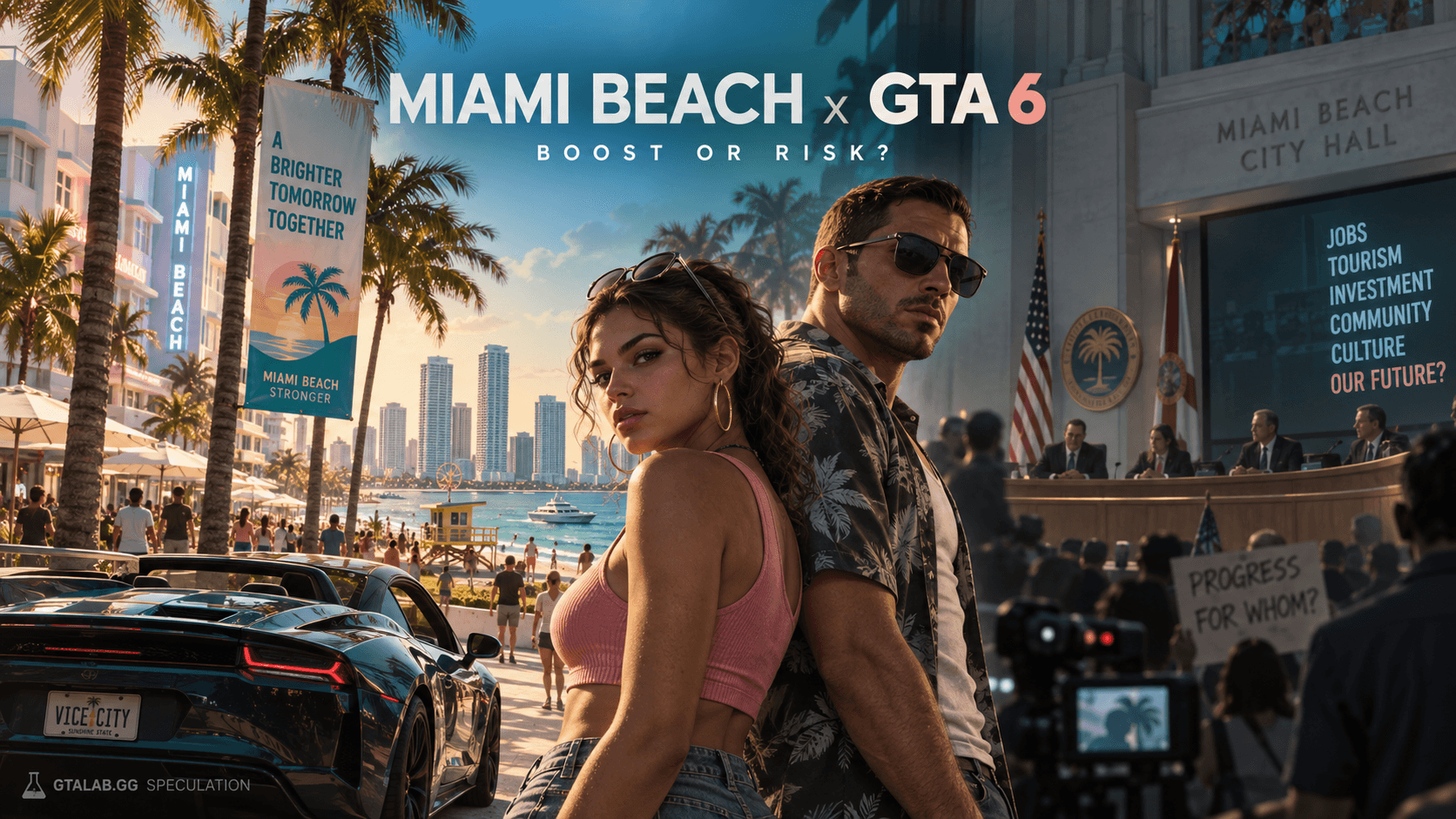
A real city. A fictional crime sandbox. And a $3 million deal that split elected officials down the middle. The GTA 6 Miami Beach partnership isn't just a marketing stunt — it's a stress test for how far a game synonymous with virtual lawbreaking can go before the real world pushes back.
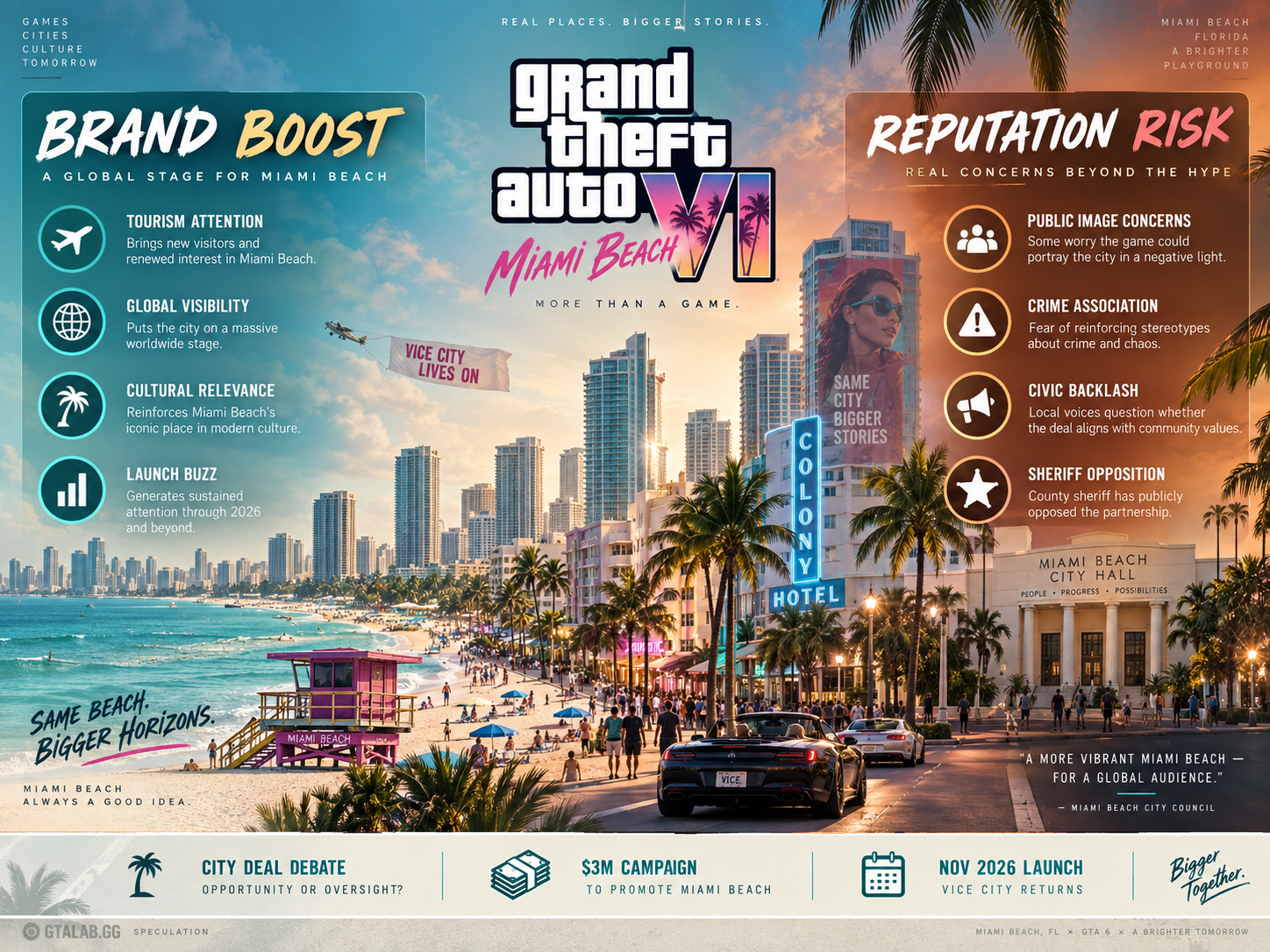
Miami-Dade County commissioners voted 4-3 in favor of entering negotiations with Rockstar Games for a promotional campaign running October 15 through December 31, 2026 — bracketing GTA 6's November 19 launch. The pitch deck reportedly includes airport plane wraps at MIA, a "Port Gellhorn" waterfront mural, and beach-facing activations branded with the word "Vice City" and the Roman numeral VI. Three commissioners voted no. The Miami-Dade County Sheriff went further and publicly urged the county to walk away entirely, citing the game's glorification of criminal activity.
So: is this deal good or bad for GTA 6's image? The honest answer is that it depends entirely on which room you're sitting in.
What the Deal Actually Is — and What It Isn't
First, precision matters here. This is not an official partnership announcement from Rockstar Games or Take-Two Interactive. What exists, as of writing, is a commission-approved mandate to negotiate with Rockstar. The final terms, the dollar figure, and the specific activations are still being worked out. Treat any headline calling this a "done deal" with skepticism until Rockstar or Take-Two put out a press release.
What is confirmed: Miami-Dade officials received an outreach from Rockstar, responded with a detailed pitch deck, and a majority of commissioners green-lit the conversation. The $3 million figure appears to represent projected revenue to the county (est.), not a Rockstar payment amount — though the exact financial structure hasn't been publicly disclosed in full.
The Case For: Why This Is a Brand Win for Rockstar
Mainstream legitimacy, on government letterhead
For decades, GTA has fought a specific perception war: that it is a product for basement-dwelling delinquents, not a cultural institution. A formal partnership with a U.S. county government — however contested — rewrites that narrative in one move. When a city puts your logo on airport planes, it is implicitly endorsing you as a tourism draw, not a social threat.
The scale matters too. GTA 6 is already tracking as one of the most-anticipated entertainment releases in history — Trailer 1 crossed 175 million YouTube views. But trailer views are passive. Physical activations in a real city transform passive hype into lived experience. Tourists photograph a Vice City mural in Miami and post it. That's earned media Rockstar couldn't buy at any price.
Vice City is already Miami — this just makes it official
The GTA 6 Vice City real life connection isn't new. Rockstar has drawn on Miami's geography, culture, and architecture since Vice City in 2002. The Venetian Causeway, Art Deco South Beach storefronts, the neon-soaked nightlife — all of it has been in the series for 24 years. This deal simply closes the loop: the city that inspired the fiction now co-brands with it.
That's not embarrassing for Miami. It's what cities like Salzburg did with Mozart, or what New Zealand did with The Lord of the Rings. Cultural geography as tourism product. The question is whether Miami's political class has the stomach for it.
The numbers argument is hard to ignore
GTA 6 will have an audience measured in the hundreds of millions within its first year. Every piece of Miami-branded content that surfaces in that game's marketing ecosystem — social posts, preview articles, YouTube reactions — is a free impression for Miami tourism. The county's pitch deck reportedly framed this explicitly as a way to reach a global audience that traditional tourism advertising cannot efficiently target. That framing is correct.
The Case Against: Why This Could Backfire
The sheriff's objection isn't just politics — it's a real brand risk
Miami-Dade Sheriff Rosie Cordero-Tagle's public opposition is the part of this story that Rockstar's PR team should be watching most carefully. Her argument: GTA 6 glorifies the exact criminal behavior — carjacking, police evasion, assault — that law enforcement spends resources combating in the real Miami.
That's not a fringe position. It is the same argument that has followed GTA since 1997, resurfacing every time a real-world crime gets attributed (however loosely) to the series. A city official saying "don't associate us with this game" is the kind of quote that travels. It surfaces in the next congressional hearing on gaming violence. It gives ammunition to advocacy groups. It becomes a footnote in every future debate about whether GTA 6 should be restricted.
For Rockstar, the worst outcome isn't the deal falling through. It's the deal proceeding while generating sustained negative press that reframes GTA 6's launch as "the game Miami's sheriff warned you about."
A 4-3 vote is not a mandate
Four to three is thin. It means three commissioners looked at the same pitch deck and said no. It means one vote change kills the deal. It means this story has at least two more news cycles in it before anything is finalized — and each cycle is an opportunity for the opposition to land a damaging headline. Rockstar advertising deals with cities are unprecedented at this scale, and the lack of a playbook cuts both ways.
What happens when someone gets hurt?
This is the uncomfortable scenario nobody in the pitch deck is modeling: a violent incident in Miami between October 15 and December 31, 2026 — the exact window of the Vice City activation. The causal link between video game violence and real-world behavior is not supported by peer-reviewed research. But causality doesn't matter in a news cycle. Proximity does. A Vice City mural on a Miami beach, followed by a local news story about crime that week, is a connection a headline writer will make regardless of the evidence.
Rockstar's brand can survive that. It has survived worse. But Miami's politicians cannot — and the commissioners who voted yes will feel that asymmetry if anything goes wrong.
How This Compares to GTA's History With Real Cities
Year | City / Location | Nature of Relationship | Outcome |
|---|---|---|---|
2002 | Miami (Vice City) | Fictional inspiration, no official tie | No controversy; city benefited from cultural cachet |
2008 | New York City (Liberty City) | Fictional analog, no city involvement | NYC tourism cited GTA IV as free advertising (est.) |
2013 | Los Angeles (Los Santos) | Fictional; LA tourism board unofficially embraced it | GTA V became de facto LA tourism content; no formal deal |
2026 | Miami-Dade County | Proposed formal co-branding partnership, $3M (est.) | 4-3 vote to negotiate; sheriff opposed; outcome pending |
The pattern is clear: GTA has always benefited from real-city associations without ever having to formally ask for permission. This is the first time Rockstar has apparently initiated a government partnership rather than simply absorbing a city's geography into its fiction. That's a strategic shift worth noting — and it carries risk precisely because it moves the relationship from implicit to explicit.
The Bigger Trend: Games as Tourism Infrastructure
The Miami deal, contested as it is, signals something larger about where the games industry is heading. For years, cities tolerated being fictionalized. Now they're competing to be associated with blockbuster releases. GTA 6 Miami tourism potential — the idea that players will visit Miami because they recognize it from the game — is a quantifiable economic argument that city planners are finally taking seriously.
This isn't unique to GTA. The Cyberpunk 2077 team worked with the city of Prague on architectural reference. Assassin's Creed Origins Discovery Tour became an educational tool endorsed by Egyptian cultural institutions. The trajectory is toward games functioning as interactive tourism advertising — and developers are smart enough to monetize that relationship rather than leave it on the table.
What Miami-Dade is doing is simply the most aggressive version of this trend yet. If it works — clean execution, no scandals, measurable tourism uptick — it becomes a template. Cities will line up to pitch the next Rockstar project. If it blows up, it sets the template back by a decade.
The Verdict: Net Positive, With One Major Caveat
On balance, the GTA 6 brand image benefits more from this deal than it risks. Mainstream cultural legitimacy is worth more to a franchise that has spent 25 years fighting for it than any marginal negative press from a sheriff's objection. The Vice City activations, if executed cleanly, will be among the most photographed marketing moments of 2026's entertainment calendar.
The caveat is execution. Rockstar and Take-Two have generally been excellent at controlling their own narrative — they don't do press tours, they don't over-explain, they let the product speak. A co-branding deal with a government entity introduces variables they cannot control: political turnover, local incidents, media framing decisions made by reporters who have nothing to do with gaming coverage.
That's new territory for Rockstar. And new territory, even when it's promising, is always where the unexpected happens.
FAQ
Q. Is the GTA 6 Miami Beach partnership officially confirmed? Not fully. Miami-Dade commissioners voted 4-3 to enter negotiations with Rockstar Games, but as of now no final contract has been announced by Rockstar or Take-Two Interactive. Treat it as confirmed negotiations, not a confirmed deal.
Q. Why did the Miami-Dade sheriff oppose the GTA 6 promotion? Miami-Dade County Sheriff Rosie Cordero-Tagle publicly urged the county against the deal, arguing that GTA 6 glorifies criminal activity — carjacking, police evasion, and violence — that runs counter to law enforcement's mission in the real Miami.
Q. What does the GTA 6 Vice City real life activation actually look like? According to a pitch deck presented by county officials, proposed activations include wrapped planes at Miami International Airport, a "Port Gellhorn" waterfront mural, and beach-facing branding using the words "Vice City" and the Roman numeral VI. Final activations depend on the outcome of ongoing negotiations.
Q. When would the Miami GTA 6 promotions run? The proposed window is October 15 through December 31, 2026 — bracketing GTA 6's confirmed release date of November 19, 2026.
Q. Has Rockstar ever done a formal city partnership like this before? Not at this scale. Previous GTA games drew heavily from real cities — Miami, New York, Los Angeles — but without formal government co-branding agreements. The Miami-Dade negotiation represents an unprecedented move toward official city partnerships for the franchise.