
Rockstar Games has officially confirmed that GTA 6's weather system is a ground-up rebuild — not an upgrade, a rebuild. Hurricanes can make landfall on Leonida. Tropical storms form and move across the map. Wind physically disturbs water surfaces. And more than 170 animal species inhabit the ecosystem. These aren't leaks or fan estimates. They came straight from Rockstar via a Game Informer preview.
Here's everything that's been confirmed, labeled clearly for what it is.
The Weather Engine: Re-Engineered From the Ground Up
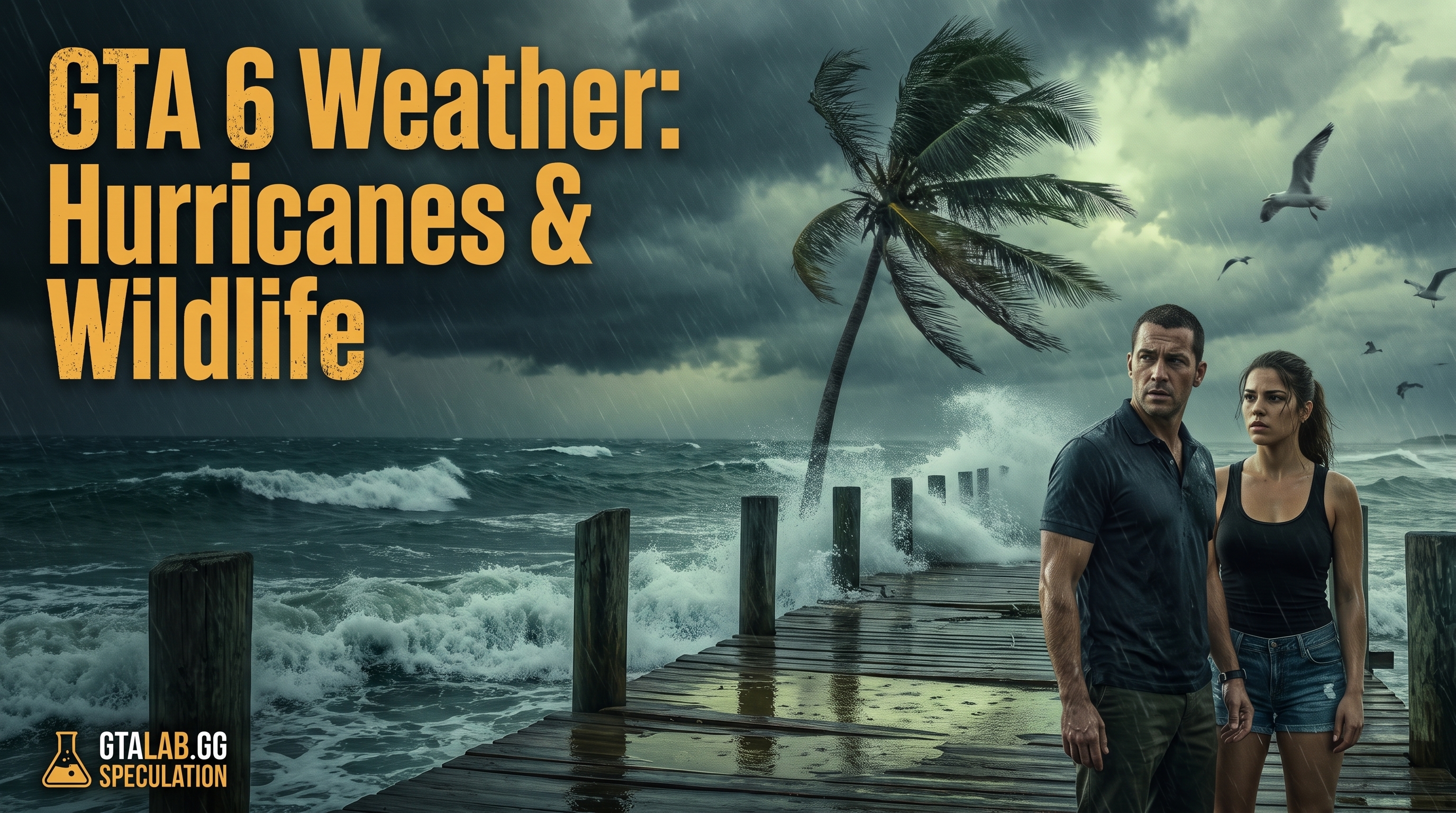
Rockstar describes GTA 6's weather as a re-engineered, localized, and persistent system — built on lessons from Red Dead Redemption 2 but fundamentally different. The studio's own language makes that distinction: it's not the same engine carried over, it's a new one informed by what RDR2 proved was possible.
What does "localized and persistent" actually mean? It means the weather isn't a global map toggle. Conditions differ across Leonida simultaneously. One part of the state could be under a tropical storm while another is clear. That's a significant step beyond GTA V's single-weather-state approach.
"Persistent" matters too. Weather systems don't just appear and vanish. They move, develop, and linger — behaving more like real atmospheric events than scripted backdrop effects.
Hurricanes and Tropical Storms: What's Confirmed
Rockstar has confirmed hurricanes and tropical storms can hit Leonida. That's the confirmed baseline. What they haven't specified:
- How frequently hurricanes occur during normal gameplay
- Whether any hurricane is tied to a story mission or scripted event
- The exact mechanical impact on driving, flying, and water navigation
- Whether players can shelter, evacuate, or interact with storm systems in structured ways
Treat any specific claims about "hurricane missions" or exact storm frequencies as unconfirmed until Rockstar addresses them directly. What's real is that the atmospheric infrastructure to support full hurricane simulation is built into the game's engine.
Wind and Water: A Physics Detail Worth Noting
One confirmed detail stands out for what it implies about simulation depth: wind will blow ripples over the water surface. Rockstar stated this explicitly.
This isn't cosmetic. A system where wind speed and direction physically interact with water surfaces suggests the weather engine is running actual environmental physics — not pre-animated weather loops. The implication is that ocean and coastal conditions will respond dynamically to storm systems rather than playing a canned "stormy ocean" animation.
For a game set on a Florida-analog coastline, that matters. Vice City's beaches, waterways, and offshore areas will all be subject to weather-driven water state changes.
Dynamic Cloud System
Confirmed alongside the storm systems: dynamic cloud formations that move across the map and generate different weather conditions in different locations. This is the mechanism behind the localized weather — clouds aren't decorative. They're the engine's way of tracking and delivering weather state across Leonida's geography.
Players could, in principle, watch a storm system approach from a distance, see the sky change, and experience conditions shift as it passes overhead. Whether Rockstar leans into that visually in moment-to-moment gameplay remains to be seen, but the technical foundation is there.
170+ Animal Species: The Confirmed Breakdown
Rockstar confirmed over 170 animal species will populate Leonida's ecosystem. The confirmed breakdown by category:
| Category | Confirmed Count | Status |
|---|---|---|
| Total species | 170+ | Confirmed |
| Bird species | 60+ | Confirmed |
| Land mammals | 30+ | Confirmed |
| Marine/aquatic life | Not specified | Unconfirmed breakdown |
| Reptiles/insects/other | Not specified | Unconfirmed breakdown |
For reference, GTA V launched with a much smaller fauna roster — the jump to 170+ is a meaningful scale increase. Red Dead Redemption 2 set a high bar for animal behavior simulation in an open world, and Rockstar appears to be applying that same philosophy to a subtropical environment.
What Does 60+ Bird Species Actually Mean for a Game?
More than 60 bird types is a specific, large number. In RDR2, birds weren't just visual filler — they responded to player proximity, weather, and time of day. If Rockstar applies similar behavioral logic in GTA 6, the gta 6 animals system isn't about headcount. It's about ecosystem behavior.
A subtropical Florida-analog setting gives this real grounding. Pelicans, herons, gulls, raptors, migratory species — 60+ bird types maps naturally onto what a Leonida coastline and inland wetlands would actually support. That's the kind of world-building detail that makes an open world feel inhabited rather than populated.
How the Weather and Animal Systems Connect
Here's the part that's easy to miss: the weather and wildlife systems aren't independent features. They interact.
In a functioning ecosystem simulation, animals respond to weather. Birds shelter before storms. Marine life behaves differently under heavy swells. Mammals seek cover. If GTA 6's gta 6 weather system is truly localized and persistent, and the animal population is as large as confirmed, the logical design outcome is weather-responsive wildlife behavior.
Rockstar hasn't confirmed that specific interaction in detail. But the architecture — a physics-driven weather engine and a 170-species ecosystem in the same world — makes it the most plausible outcome. Call it a reasonable inference, not a confirmed feature.
Leonida as a Setting: Why This All Makes Sense
GTA 6's Leonida is a thinly veiled Florida. That geographic choice isn't incidental to the weather system — it's the entire justification for it. Florida is:
- One of the most hurricane-active coastlines in the Western Hemisphere
- Home to some of the most biodiverse ecosystems in North America (Everglades, Keys, coastal wetlands)
- A place where weather is a genuine, daily force — not just occasional atmosphere
Building a credible Leonida without a serious weather engine and rich wildlife population would have been a missed opportunity. Rockstar clearly didn't miss it.
What's Still Unknown
To keep the confirmed/unconfirmed line clean, here's what remains unanswered as of GTA 6's November 19, 2026 release date:
- Hurricane frequency — how often do they occur in free roam?
- Story integration — is any major storm scripted into the narrative?
- Gameplay mechanics — what does driving, flying, or boating in a hurricane actually feel like in terms of control?
- Animal interaction depth — hunting, photography, passive observation only?
- Full species breakdown — what fills the gap between 60+ birds, 30+ mammals, and 170+ total?
These are fair questions. They don't have confirmed answers yet. That's the honest status of the information.
FAQ
Q. Are hurricanes confirmed in GTA 6? Yes. Rockstar officially confirmed that hurricanes and tropical storms can occur in Leonida. Exact frequency and whether any storm is story-tied have not been detailed.
Q. How many animals are in GTA 6? Rockstar confirmed over 170 animal species, including more than 60 bird species and more than 30 land mammals. The full breakdown by category has not been specified.
Q. How does the GTA 6 weather system work? It's a re-engineered, localized, and persistent system. Weather differs across Leonida simultaneously, driven by dynamic cloud formations that move across the map. Wind physically generates ripples on water surfaces.
Q. Is the GTA 6 weather system based on Red Dead Redemption 2? Rockstar says it was informed by RDR2's system but is fundamentally re-engineered — not the same engine carried over.
Q. When does GTA 6 release? GTA 6 launches on November 19, 2026, for PS5 and Xbox Series X|S. A PC version has not been announced.