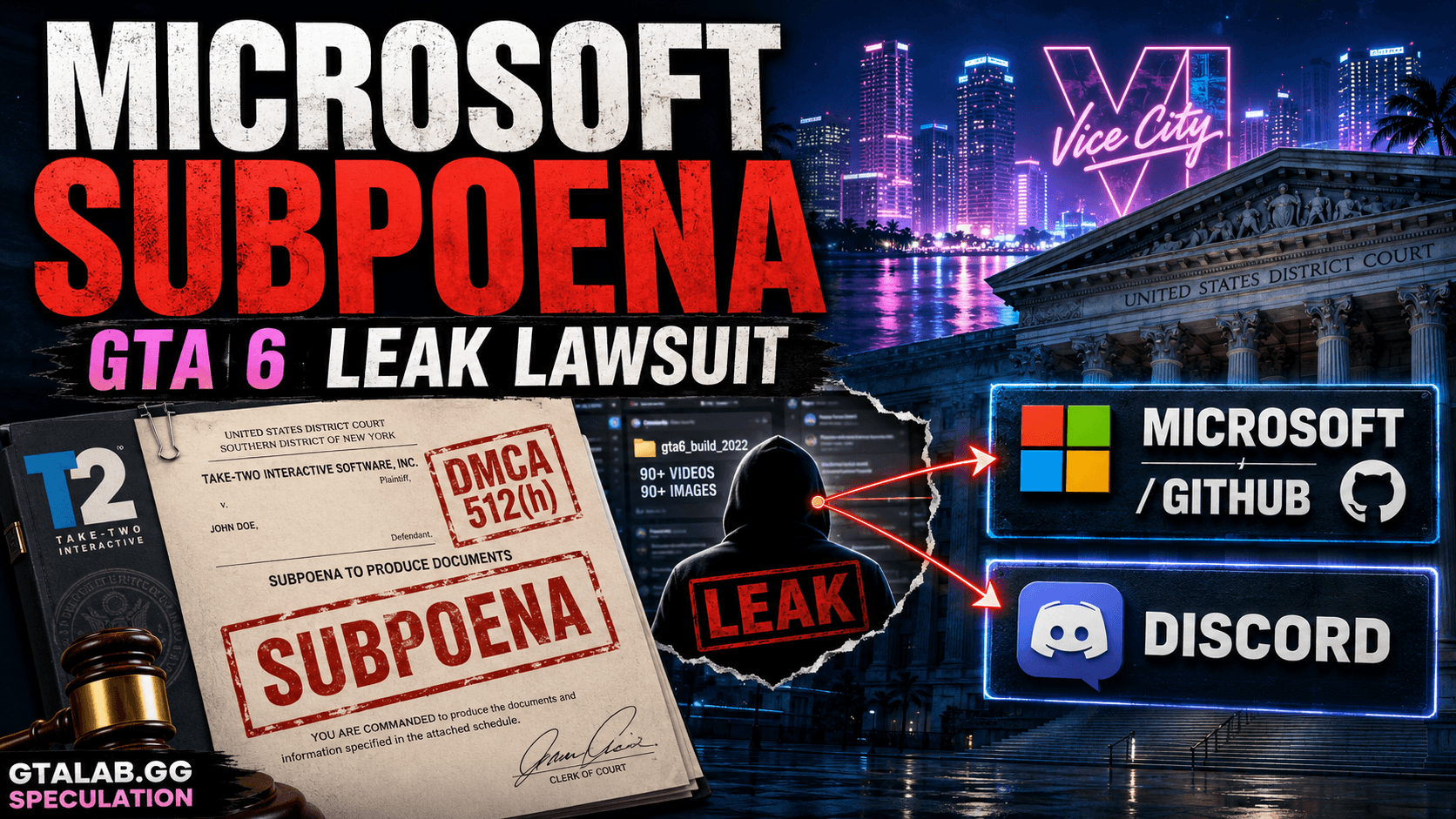
DMCA takedowns weren't enough. On August 20, Take-Two Interactive filed two subpoenas in the U.S. District Court for the Southern District of New York — one targeting Microsoft, the other targeting Discord — in a bid to unmask the person or persons behind the GTA 6 leaks. The GTA 6 leak lawsuit has officially entered Big Tech territory, and the legal pressure is only escalating.
This is not a routine cease-and-desist. This is a game publisher compelling two of the world's most powerful tech companies to hand over account data under federal copyright law. It's worth understanding exactly how they're doing it, why those two companies specifically, and how this fits into Take-Two's broader legal offensive.
What the Subpoenas Actually Say
Both requests were filed under Section 512(h) of the Digital Millennium Copyright Act (DMCA), a provision that allows copyright holders to demand platform operators disclose the identity of alleged infringers — without requiring a judge to rule on the underlying merits of the case first. The law firm Kirkland & Ellis filed both requests on Take-Two's behalf.
The subpoenas describe the protected material broadly: "audiovisual content, artwork, images, dialogue, or other creative elements" — language that covers everything from the September 2022 gameplay footage breach to any subsequent material linked to the handle "CyberLeek."
Critically, as TorrentFreak noted, a judge must still formally issue these subpoenas before Microsoft and Discord are legally obligated to act. The requests have been filed; they have not necessarily been issued yet. That distinction matters — but given the DMCA's expedited track record, formal issuance is typically a formality once the paperwork is in order.
Why Microsoft? The GitHub Connection
The Microsoft angle is the most significant part of this story, and it's one most coverage has underplayed.
According to the subpoena directed at Microsoft, GTA 6 copyrighted content was posted to GitHub — Microsoft's developer platform, acquired in 2018 for $7.5 billion. GitHub is not a gaming forum or a file-sharing site. It's a professional code and content repository used by developers worldwide. Posting stolen game assets there suggests the leaker had some degree of technical sophistication, or was using GitHub's infrastructure as a distribution vector knowing it would take longer for Rockstar's DMCA radar to catch it.
Take-Two wants to know: who owns that GitHub account? What IP address logged in? What email was used to register it? Microsoft holds all of that.
Could Xbox or Azure Be Involved?
The subpoena is specifically directed at the GitHub platform, but Microsoft's ecosystem is deeply interconnected. A single Microsoft account can span Xbox Live, GitHub, Outlook, and Azure. If Take-Two's legal team obtains account-linking data, one GitHub profile could potentially unravel a much larger digital trail. That's the calculus here — and it's why Microsoft, not just a smaller hosting service, is in the crosshairs.
Why Discord? The Private Server Problem
The Discord subpoena alleges that leaked GTA 6 material was shared through Discord's platform — most likely through private or semi-private servers where moderation is sparse and content spreads fast before takedown requests can land.
Discord's position is uncomfortable but familiar. The platform has faced similar requests in prior IP cases. Under DMCA 512(h), Discord — like any qualifying service provider — is required to designate an agent to receive such subpoenas. Whether they cooperate fully, contest the scope, or seek to narrow the request will be worth watching. Both companies have until September 4 to comply.
How This Fits the Broader Legal Offensive
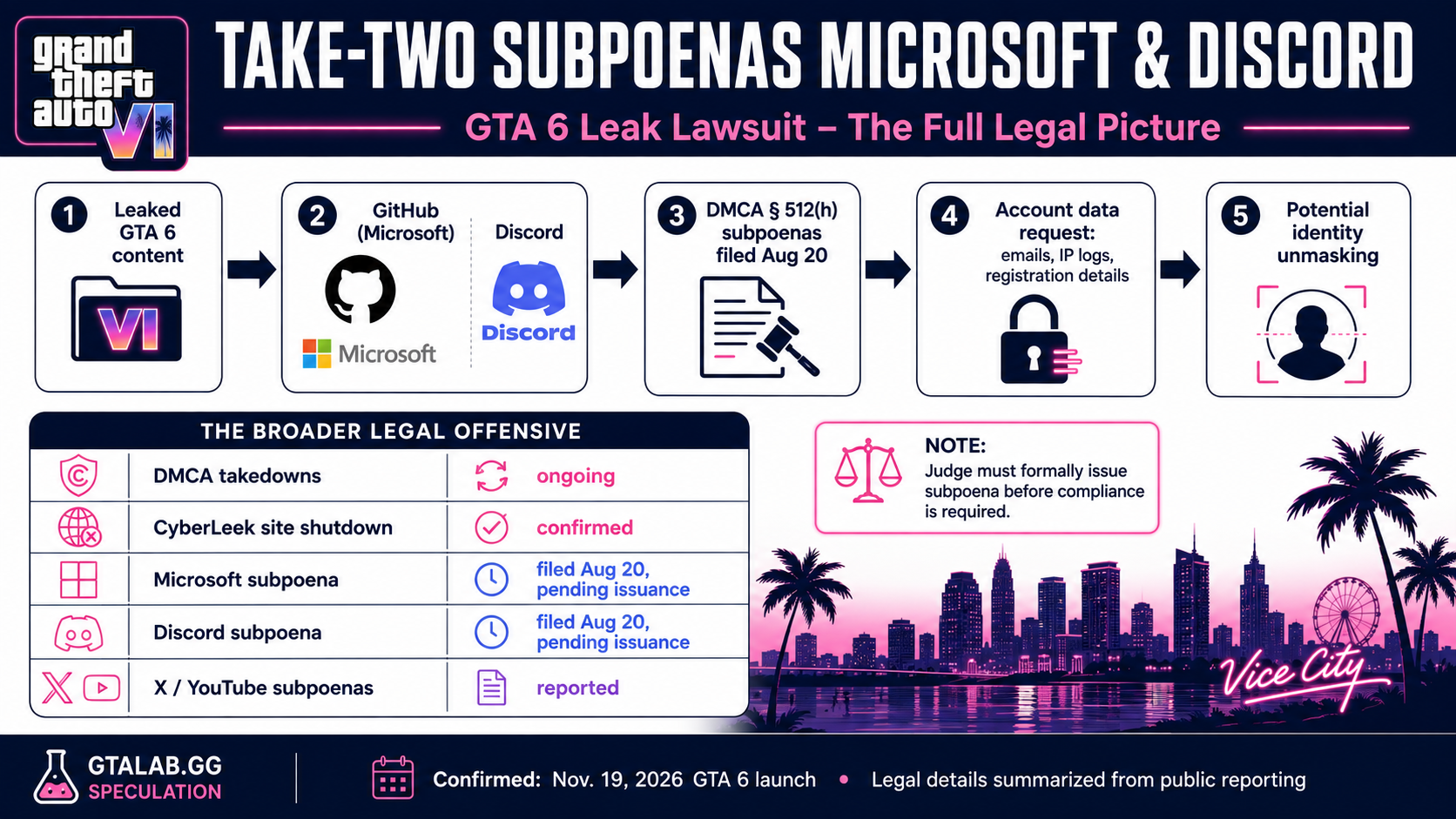
The Microsoft and Discord subpoenas don't exist in isolation. They are the latest escalation in what is now a coordinated, multi-front legal strategy from Take-Two. Here's the full picture:
Action | Target | Tool Used | Status |
|---|---|---|---|
Mass DMCA takedowns | Social platforms, video hosts | DMCA notices | Confirmed, ongoing |
CyberLeek site shutdown | cyberleek.com and mirrors | Legal threats / hosting pressure | Confirmed, site offline |
Cryptocurrency tracing | Alleged leaker's wallets | On-chain forensics (est.) | Rumored / Leak |
DMCA subpoena — Microsoft | GitHub account data | DMCA § 512(h), federal court | Filed Aug 20, pending issuance |
DMCA subpoena — Discord | Server/account data | DMCA § 512(h), federal court | Filed Aug 20, pending issuance |
Subpoenas — X and YouTube | Account/upload data | DMCA § 512(h) | Reported (TorrentFreak) |
The pattern is clear: Take-Two is not trying to win one battle. They're trying to close every exit. DMCA takedowns suppress the content. Site shutdowns cut off distribution hubs. Crypto tracing follows the money. And federal subpoenas to Microsoft, Discord, YouTube, and X force the infrastructure itself to unmask whoever is behind it.
Is Subpoenaing Big Tech Actually Rare?
For individual creators or small studios, going after Microsoft in federal court would be unthinkable. For Take-Two — a publisher with a $4+ billion market cap and Kirkland & Ellis on retainer — it is aggressive but not unprecedented.
What is relatively unusual is the breadth. Subpoenaing four or more major platforms simultaneously signals that Take-Two either has strong reason to believe the leaker used multiple services in concert, or that they're casting a wide net hoping one platform yields the decisive identity data. DMCA 512(h) makes this tractable because each subpoena doesn't require its own full lawsuit — they're more like legally compelled discovery requests tied to the underlying infringement claim.
The honest answer: this is one of the more aggressive multi-platform DMCA identity hunts in gaming history. The closest comparison is prior actions against large-scale ROM sites or modchip distributors — but those rarely reached GitHub.
What Happens If Microsoft or Discord Pushes Back?
Either company could theoretically challenge the scope of a subpoena — arguing it's overbroad, seeks information beyond what DMCA 512(h) permits, or raises user privacy concerns. In practice, major platforms often negotiate the scope rather than mount full legal opposition, especially when the underlying infringement claim is well-documented.
The GTA 6 leak case has one of the most thoroughly documented paper trails in gaming history — the September 2022 breach alone involved over 90 video clips, and Rockstar confirmed the leak publicly. That documentation makes it very difficult for any platform to argue Take-Two lacks a colorable infringement claim.
What This Means for the GTA 6 Court Case Going Forward
If the subpoenas are issued and complied with, Take-Two gets account data — email addresses, IP logs, registration details — that can be cross-referenced with what investigators already know. Combined with any cryptocurrency tracing, a coherent identity picture could emerge quickly.
The GTA 6 court case is not about recovering the leaked footage. That ship sailed in 2022. This is about deterrence — making the legal consequence of leaking Rockstar material severe enough that it discourages future actors. A confirmed identity, a civil lawsuit, and potentially a referral for criminal prosecution under the Computer Fraud and Abuse Act would send that message loudly.
GTA 6 launches on November 19, 2026. Take-Two's legal team appears determined to reach that date with every loose end tied up — or at least tied down in court.
FAQ
Q. What is the Take-Two Microsoft subpoena in the GTA 6 leak lawsuit about? Take-Two filed a DMCA Section 512(h) subpoena against Microsoft on August 20, seeking account information tied to GitHub content that allegedly contained leaked GTA 6 copyrighted material. The goal is to identify the person behind the leaks.
Q. Does the subpoena mean Microsoft has already handed over data? No. As of the filing date, the subpoenas have been requested in the U.S. District Court for the Southern District of New York but must be formally issued by a judge before Microsoft or Discord are legally obligated to comply. Both companies have until September 4 to respond once issued.
Q. Why did Take-Two target GitHub specifically? According to the subpoena language, GTA 6 copyrighted content was posted directly to GitHub, Microsoft's developer platform. GitHub accounts are linked to broader Microsoft identity data, making them a potentially rich source of identifying information for investigators.
Q. What is CyberLeek, and how does it connect to the GTA 6 court case? CyberLeek was a website associated with the distribution of leaked GTA 6 material. It has since been taken offline, reportedly as a result of legal pressure from Take-Two. The Microsoft and Discord subpoenas are part of the same broader legal campaign to identify the individual or group behind the CyberLeek handle.
Q. Could the GTA 6 leaker face criminal charges, not just a civil lawsuit? Potentially. While Take-Two's current actions are civil — DMCA subpoenas, identity unmasking — if a confirmed identity is established, the case could be referred for criminal investigation under statutes like the Computer Fraud and Abuse Act. No criminal charges have been filed as of this writing.