
Rockstar has confirmed it. The GTA 6 weather system has been "re-engineered" from the ground up, and that word — re-engineered — is doing a lot of heavy lifting. Most coverage stops at "hurricanes confirmed" and moves on. That's where this article starts.
What does a fundamentally rebuilt weather simulation actually change about how you play? Combat, travel, side missions, NPC behavior — every system that relies on the environment gets touched. Here's what we know for certain, what we can estimate from comparable technology, and what remains genuinely unclear heading into the November 19, 2026 launch.
What Rockstar Actually Said — And What It Means
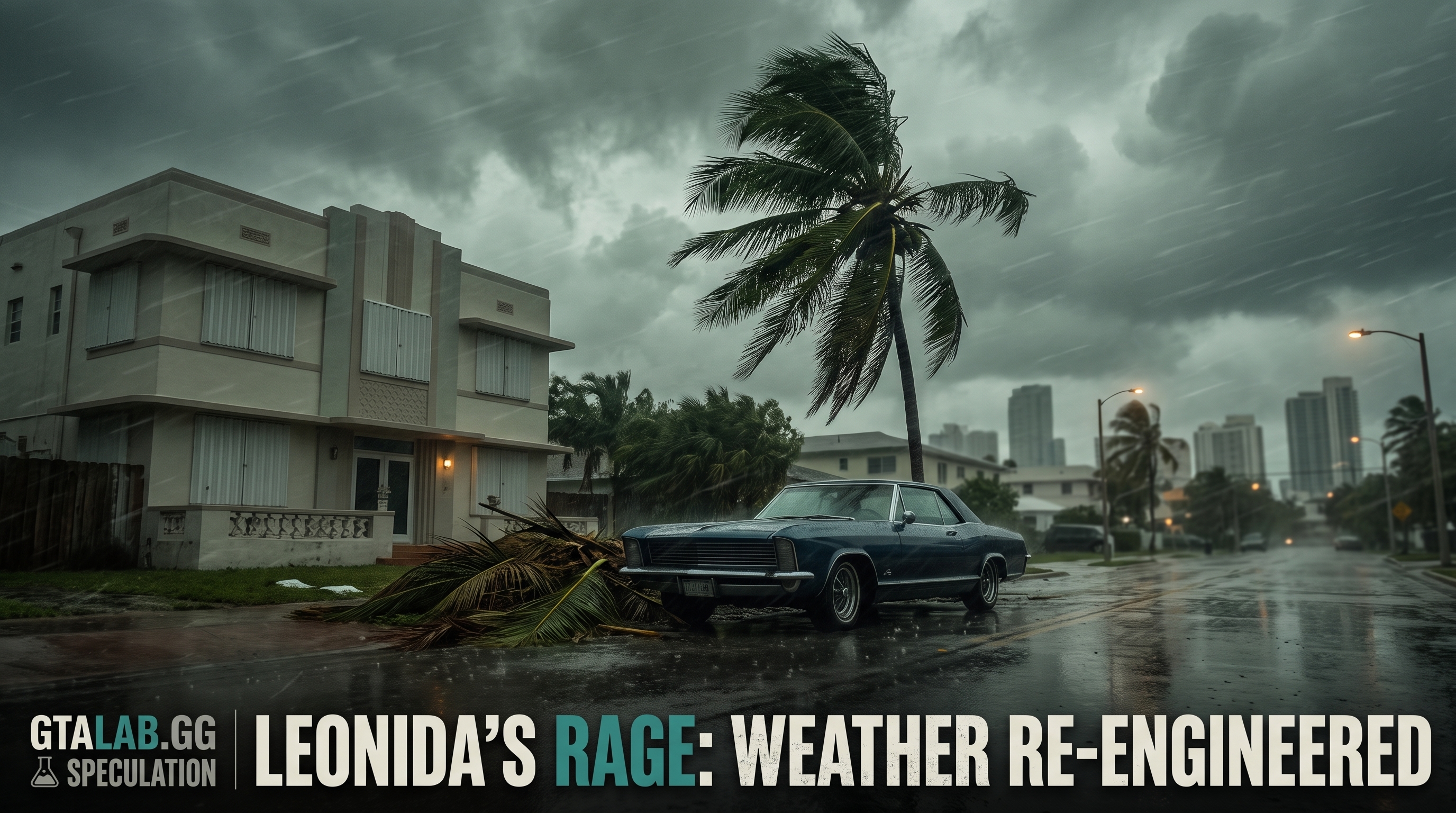
Owen Shepherd, Rockstar's vice president of art for lighting and rendering, described the goal in specific terms: the weather in Leonida should feel "localized and persistent" and "dynamically solid" — achieving a sense of scale the studio has never attempted before. Fully dynamic cloudscapes. A broad spectrum of conditions. Weather that reads as belonging to a specific place, not a generic game world.
That framing is important. "Localized and persistent" means a storm doesn't just spawn overhead and disappear. It moves, it lingers, and it behaves differently depending on where in Leonida you are. The Florida analog — Leonida's real-world reference point — has a genuinely varied climate: humid subtropical inland, volatile coastal, prone to sudden afternoon thunderstorms and, yes, full-scale hurricanes. Rockstar appears to be modeling that range.
"We wanted the weather to feel dynamically solid — a broad spectrum that gives you a sense of scale we've never done before." — Owen Shepherd, VP of Art, Rockstar Games
The GTA 6 Hurricane: Confirmed, But What Does That Actually Look Like?
A GTA 6 hurricane is confirmed. The question the community keeps circling is whether it functions as a scripted set piece — spectacular but passive — or as a fully systemic event that reshapes the open world while it's happening.
The language Rockstar uses points toward the systemic end. "Dynamically solid" weather doesn't sound like a cutscene trigger. But we don't have a confirmed gameplay demo showing a hurricane in freeplay, so the honest answer is: we don't know the full scope yet.
What we can map from the confirmed details:
- Wind-driven water surfaces — Rockstar has confirmed waves respond to wind conditions. In a hurricane scenario, open water near Vice City's coast would become actively hostile to boats and swimmers.
- Fully dynamic cloudscapes — The sky isn't a static texture swap. Cloud formations build and shift, which means a hurricane's approach would be visually telegraphed over time, not a sudden loading-screen transition.
- Localized behavior — Storm intensity likely varies by zone. Inland Leonida may see heavy rain and reduced visibility while the coast takes the full force. That's realistic to Florida geography and consistent with "localized" weather design.
How GTA 6 Tropical Storms Compare to RDR2's Weather
Red Dead Redemption 2 is the clearest benchmark Rockstar has set for environmental simulation. Its weather system was, at release, best-in-class: blizzards that genuinely slowed horse movement, thunderstorms that spooked animals, humidity that affected Arthur's clothing. It was reactive. But it had a ceiling.
| Feature | RDR2 | GTA 6 (Confirmed) | GTA 6 (est.) |
|---|---|---|---|
| Dynamic cloud formation | Partial (region-triggered) | Fully dynamic cloudscapes | Real-time storm buildup visible |
| Wind effect on water | Minimal | Confirmed wind-driven waves | Navigable water becomes hazardous in storms |
| Localized persistence | Some (blizzards in Grizzlies) | Explicitly confirmed goal | Storm systems track across map over time |
| Hurricane / tropical storm | Not present | Confirmed | Systemic impact on travel, combat, missions (est.) |
| NPC weather reaction | NPCs seek shelter, wildlife retreats | Not yet detailed | Crowd density shifts, police response changes (est.) |
The gap between RDR2 and GTA 6's stated ambition is significant. RDR2 used weather as atmosphere. GTA 6 appears to be positioning weather as a variable — something that changes what's possible in a given moment.
Combat in a GTA 6 Tropical Storm: The Gameplay Variables
This is where the re-engineered system starts to produce real gameplay consequences. Consider what "localized, persistent" wind and rain actually means for a firefight.
Visibility and Targeting
Heavy rainfall and wind-driven debris reduce sightlines. In GTA 5, rain was cosmetic — it didn't meaningfully affect gunplay. If GTA 6's weather is as systemic as Rockstar implies, reduced visibility during a GTA 6 tropical storm could change engagement ranges, make cover positioning more important, and affect whether NPCs or police can accurately locate the player.
Vehicle Handling
Wind-driven wave simulation on water surfaces is confirmed. That same wind logic almost certainly affects vehicle physics — particularly motorcycles, light aircraft, and boats. A hurricane-force wind event during a chase or getaway sequence would introduce a layer of chaos that GTA 5 never attempted. This is an estimate based on how wind simulation typically extends across physics systems, not a confirmed detail.
Wanted Level Dynamics
Here's a scenario worth thinking about: if police helicopter deployment is standard in a 4–5 star wanted level, does a full hurricane ground air support? In a realistic simulation, it would have to. That creates a natural wanted-level exploit window that players will discover and abuse immediately — and Rockstar almost certainly knows it. Whether they account for it in wanted level design or let it stand as an environmental mechanic is an open question. (est.)
Side Missions and Weather as a Timer
Rockstar's own promotional framing suggests Leonida's weather has a sense of geography. That has direct implications for mission design.
In RDR2, certain missions were weather-adjacent — a blizzard set the mood for an early chapter, a storm covered a boat ambush. But the weather was largely authored. If GTA 6's weather system is truly dynamic, mission designers have a new tool: weather as an organic pressure mechanic.
- A side mission near the coast that gets harder — or unlocks differently — depending on whether a storm is approaching. (est.)
- Smuggling runs that become significantly more profitable, and more dangerous, during a hurricane event when police air cover is grounded. (est.)
- Rescue or disaster-response missions triggered by hurricane aftermath — flooding, stranded NPCs, infrastructure damage. Consistent with Leonida's Florida setting and Rockstar's 170+ confirmed animal species suggesting a living ecosystem.
None of these are confirmed mission types. But they are the logical design space that a "dynamically solid" weather system opens up, and Rockstar has a track record of using environmental systems to layer mission variety.
NPC AI and Crowd Behavior During Storms
Rockstar confirmed over 170 animal species in GTA 6, with behavior systems sophisticated enough to warrant specific callout. Wildlife in RDR2 retreated from storms. With a more complex Leonida ecosystem, storm behavior in animals and pedestrian NPCs should be correspondingly richer.
What changes when a GTA 6 hurricane makes landfall?
- Pedestrian density on streets drops sharply — realistic evacuation behavior. (est.)
- Certain NPC archetypes (beachgoers, street vendors, outdoor event crowds) disappear entirely. (est.)
- Emergency vehicle traffic increases — storm response units, flooding scenarios. (est.)
- Wildlife moves inland, creating different hunting or encounter conditions. (est.)
The cumulative effect is a world that feels like it's actually responding to the weather — not just running a different particle effect overhead.
The One Honest Uncertainty
All of this analysis rests on Rockstar's stated design intent and extrapolation from confirmed systems. We have not seen extended freeplay footage of a GTA 6 tropical storm. We don't know if hurricanes are permanent world events, seasonal cycles, or story-gated. We don't know if the wind physics that affect water surfaces also affect projectile ballistics or vehicle handling at hurricane force.
What we do know: Rockstar used the word "re-engineered." For a studio that already built one of the best weather systems in open-world history with RDR2, that word means something. They're not adding rain varieties. They're rebuilding the underlying simulation.
The GTA 6 weather system isn't a feature. It's a gameplay variable. And on November 19, 2026, we'll find out exactly how deep that rabbit hole goes.
FAQ
Q. Is the GTA 6 hurricane a confirmed feature? Yes. Rockstar has officially confirmed that GTA 6 will include hurricanes as part of its re-engineered, fully dynamic weather system set in the Florida-inspired state of Leonida.
Q. How does the GTA 6 weather system differ from GTA 5? GTA 5's weather was largely cosmetic — rain affected visuals but not gameplay in meaningful ways. GTA 6's weather is described as "re-engineered" with fully dynamic cloudscapes, wind-driven water surfaces, and localized persistent storms, suggesting it functions as an active gameplay variable rather than a backdrop.
Q. Will tropical storms in GTA 6 affect combat and police chases? No detail has been officially confirmed on this yet, but based on the confirmed wind and wave physics systems, it's reasonable to estimate that severe storms will impact vehicle handling, visibility during gunfights, and potentially ground police air support. These remain estimates, not confirmed mechanics.
Q. How does GTA 6's weather compare to RDR2? RDR2's weather was best-in-class for its time — regionally triggered storms that affected movement and NPC behavior. GTA 6 explicitly goes further with fully dynamic cloud formation, confirmed hurricanes, and a design goal of weather that feels "localized and persistent," suggesting a more systemic, simulation-level approach.
Q. When does GTA 6 release? GTA 6 launches on November 19, 2026 for PlayStation 5 and Xbox Series X|S. A PC release date has not been announced.