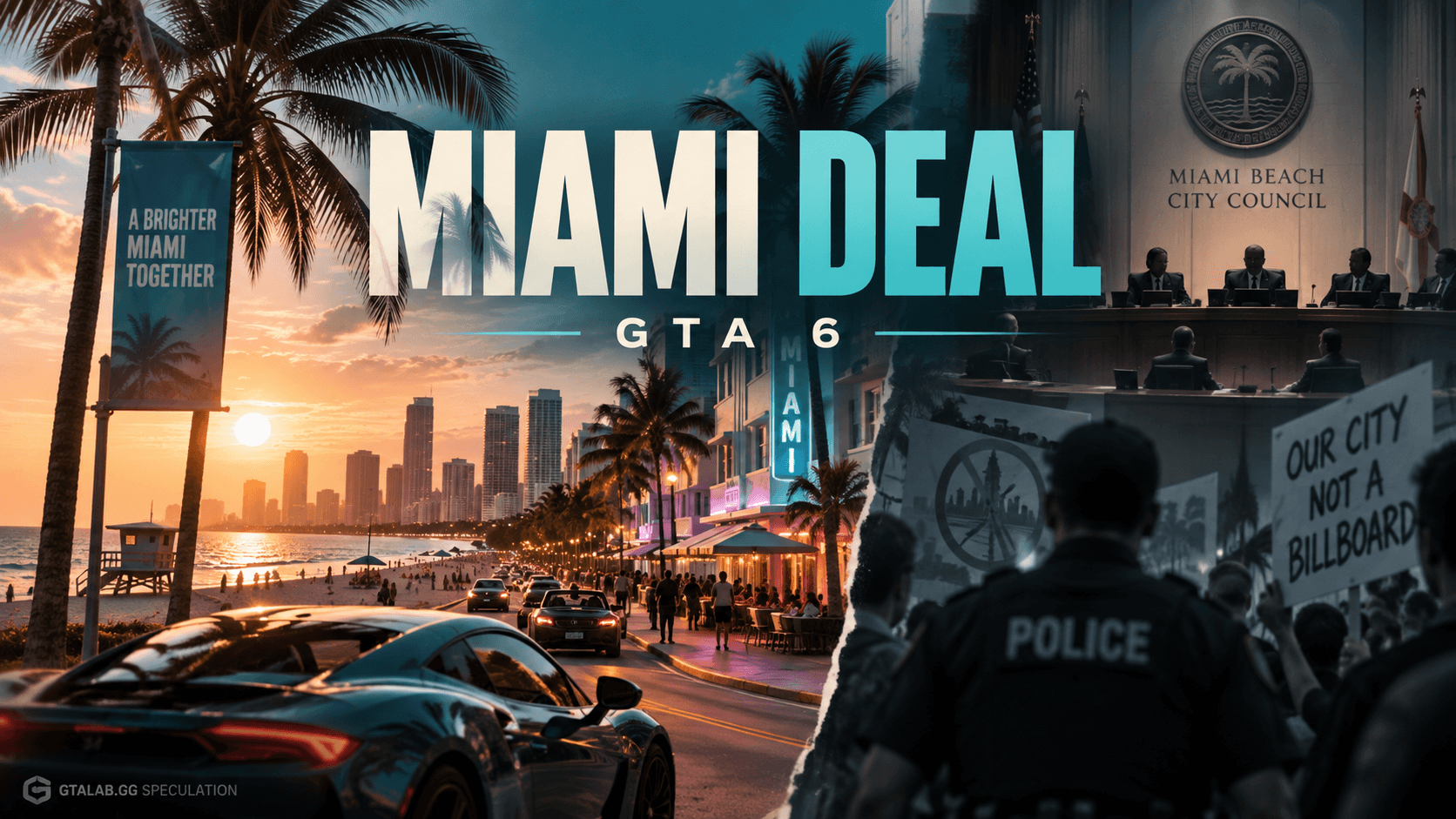
A video game just walked into a city council chamber and started a political fight. Miami Beach voted to approve a Rockstar Games marketing partnership tied to GTA 6 — but the path to that vote was anything but smooth. On one side: tourism dollars and cultural cache. On the other: a county sheriff who didn't want his city's name on a game built around guns, drugs, and crime. That tension is still live, and it matters far beyond Florida.
This is the first time a major American city has formally debated whether to sell its brand to a Grand Theft Auto title. It won't be the last.
What Actually Happened: The Vote, the Money, the Opposition
According to reporting from Polygon, Miami Beach city officials voted in favor of a roughly $3 million GTA 6 marketing campaign — one that would lean into the game's Vice City setting, which has been openly modeled on Miami since the original GTA: Vice City in 2002. The deal would put real Miami Beach branding, imagery, and promotional co-operation behind Rockstar's November 2026 launch.
That sounds like a straightforward tourism play. It wasn't.
Before the vote passed, the Dade County Sheriff's office came out publicly against the collaboration. The argument was blunt: GTA 6 is a game where the player commits crimes — carjackings, shootings, drug runs — and associating the city's official identity with that content sends the wrong message. Per GIGAZINE's coverage of the opposition, the sheriff's office cited the game's "large number of criminals" as incompatible with the city's public image.
The counter-argument from supporters was equally blunt: Vice City is already Miami. The branding ship sailed in 2002. Refusing the deal doesn't erase the association — it just means Miami Beach collects zero dollars from it.
The $3 Million Question: What Does Miami Beach Actually Get?
The publicly reported figure is $3 million. What that buys — and for whom — is worth unpacking, because municipal marketing deals at this scale have a standard structure.
Element | Likely Terms (est.) | Status |
|---|---|---|
Cash payment to city | $3M base fee (est.) | Reported, unverified breakdown |
Tourism board co-branding | Visit Miami/Vice City cross-promotion | Rumored component |
In-game location fidelity agreement | No explicit city liability for fictional crime | Standard boilerplate (est.) |
Duration | Tied to launch window, Nov 2026 (est.) | Unconfirmed |
Exclusivity | Unknown | Not reported |
The honest answer: the full contract terms have not been made public. What we know is the headline number and the vote outcome. Everything else above is a reasonable estimate based on how comparable city-brand deals are structured. Treat any more specific claim as speculation until the city releases the agreement.
Has This Ever Happened Before? The Precedent Problem
City-and-game marketing deals are not new — but they've almost always flowed the other way. Cities have licensed their names and imagery to games as passive IP (New York City's appearance in Spider-Man, Chicago in Watch Dogs), usually without a formal cash payment and with minimal political friction.
What Miami Beach did is structurally different: a municipal government actively voting to accept money from a game publisher in exchange for co-promotional support. That's closer to a corporate sponsorship of a public institution than a passive IP license. The closest precedents include:
Las Vegas / various racing games — The Las Vegas Convention and Visitors Authority has co-promoted titles like Forza Motorsport. But Las Vegas's brand is vice; the politics are simpler.
Detroit / Forza Horizon 3 — Motor City leaned into the series' car culture angle. No significant opposition.
London / Watch Dogs Legion — Ubisoft used London's skyline extensively. No formal city payment involved.
None of those generated a law enforcement official going on record against the deal before the vote. Miami Beach is the first case where a city's own public safety leadership publicly opposed a game partnership. That's the precedent that matters here.
GTA 6 and Real Miami: The Line That's Already Gone
Part of why the opposition argument struggles is that Rockstar didn't wait for permission. GTA 6's Vice City is already Miami Beach in extraordinary detail. Fans have already cross-referenced trailer and screenshot footage against real addresses — IGN reported that players located what appears to be the real-life building that inspired Jason and Lucia's apartment in Vice City, matching architectural details and street layouts with striking accuracy.
Rockstar's recent screenshot releases ahead of the November launch — showing beach scenes with NPC density and environmental detail that reportedly silenced skeptics who thought the trailers were pre-rendered — only deepened the Miami connection. The sand, the art deco facades, the water color: it's not like Miami Beach. It is Miami Beach, rendered at a fidelity that functions as free advertising regardless of any formal deal.
The sheriff's office was, in a sense, arguing against something that had already happened.
The Cultural Fault Line: Who Owns a City's Image?
Here's the part the standard gaming-news take skips. This vote wasn't really about GTA 6. It was about a much older question: who controls how a city is represented in popular culture, and should cities profit when that representation is commercially exploited?
Miami has been "Vice City" in the cultural imagination since the cocaine-and-neon 1980s — Scarface, Miami Vice, the original GTA: Vice City. Rockstar didn't invent that identity; they inherited and amplified it. The irony is that the city's law enforcement officials — the institutional guardians of Miami's "real" image — were arguing against a deal that would let the city financially reclaim some share of a reputation it never fully controlled.
The pro-deal camp's logic is hard to dismiss: if Vice City drives even a fraction of GTA 6's global audience to search "where is Vice City in real life," Miami Beach's tourism infrastructure benefits whether or not a formal deal exists. The deal just ensures the city gets paid for it.
"Vice City is already Miami. Refusing the deal doesn't erase the association — it just means Miami Beach collects zero dollars from it."
What This Means for GTA 6 — and Every Game After It
GTA 6 launches November 19, 2026. By the time players boot it up, the Miami Beach marketing partnership will be in full effect. But the political fight that preceded it has already done something more lasting: it established that a major game release can become a municipal political issue, complete with law enforcement opposition, council votes, and public debate about civic identity.
That's new. And game publishers are watching.
If the Miami Beach deal generates measurable tourism uplift data post-launch — searches, hotel bookings, "Vice City" travel content — expect more cities to approach Rockstar (and Ubisoft, and CD Projekt Red) with their hands out. And expect more police unions, conservative councils, and community groups to push back. The Miami Beach vote may have been the first, but it reads like a template.
For now, the bottom line: the deal is approved, the money is real, and GTA 6 will carry Miami Beach's implicit endorsement into the biggest entertainment launch of 2026. Whether that's a civic embarrassment or a savvy tourism play depends entirely on who you ask — and, in November, on how many players buy a plane ticket after the credits roll.
FAQ
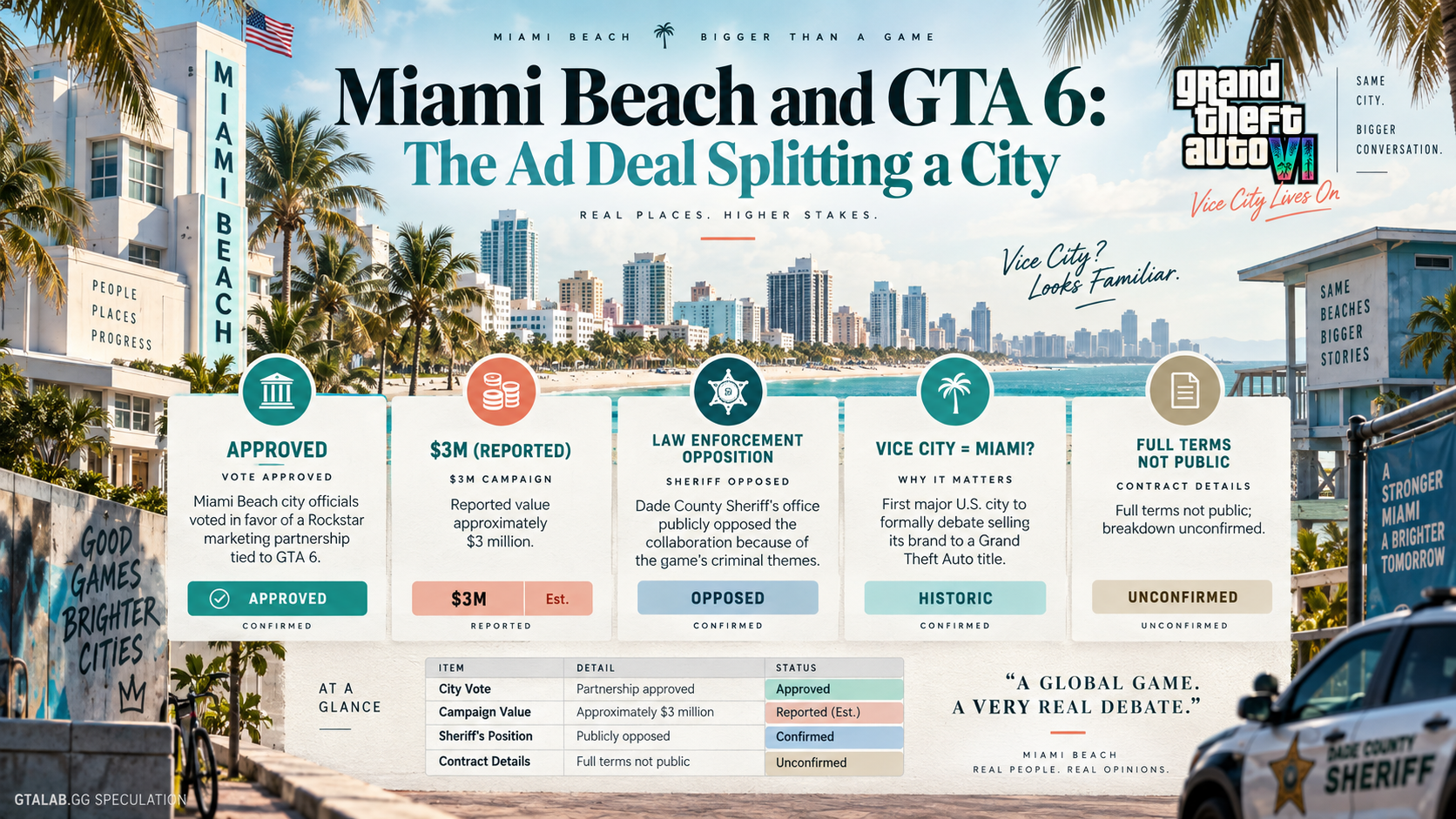
Q. Did Miami Beach officially approve the GTA 6 advertising deal? Yes. Miami Beach city officials voted in favor of a reported $3 million marketing partnership with Rockstar Games tied to the GTA 6 launch, according to Polygon. The full contract terms have not been made public.
Q. Why did the Dade County Sheriff oppose the Miami Beach GTA 6 deal? The sheriff's office argued that GTA 6's core gameplay — which revolves around criminal activity including carjackings, shootings, and drug trafficking — was incompatible with the city's public image, and that Miami Beach should not officially associate its brand with that content.
Q. Is GTA 6's Vice City actually based on real Miami Beach locations? Extensively, yes. Fans have already identified specific real-world buildings and street layouts that appear to have directly inspired in-game locations, including the apartment associated with protagonists Jason and Lucia. Rockstar has not confirmed specific location sources, but the visual fidelity to Miami Beach is widely documented.
Q. Has any other city formally partnered with a GTA game before? Not in the same way. Previous city-game associations (New York in GTA IV, Los Angeles in GTA V) were passive IP uses without formal municipal deals or cash payments. Miami Beach's voted, paid partnership is the first of its kind for the GTA franchise.
Q. How much is Miami Beach getting paid in the Rockstar deal? The reported figure is $3 million, but the detailed breakdown — what that covers, the duration, and any exclusivity terms — has not been officially disclosed. Treat any more specific figures as estimates until the city releases the full agreement.